Let me ask you something.
When was the last time you finished a full workday and still had something left in the tank?
Not dragging yourself to the car. Not counting down to the moment you could finally sit down. Not arriving home with nothing left for your wife, your children, or yourself.
You remember what that felt like. It was not that long ago. But it feels like another man's life now.
Maybe you have noticed it at work first. The sharpness that used to arrive automatically — the quick decisions, the commanding presence in a room — now takes more effort than it should. Your junior colleagues are moving faster. You tell yourself it is experience versus energy. But you know it is more than that.
Maybe you have noticed it in the gym. Or rather — you have noticed that you stopped going. Because you kept going and getting nothing back from it. The body that used to respond has stopped responding. And so you quietly cancelled the membership and told yourself you were too busy.
You are not too busy. You are too depleted. There is a difference.
Maybe your wife said something. Not in anger — worse than anger. In that quiet, half-joking way that lands harder than any argument. "You used to be fun." Or: "What happened to you?" Delivered with a small smile so it can be called a joke if you react.
You laughed it off. You have been thinking about it every single day since.
And in the bedroom — we do not need to discuss the bedroom. You know. She knows. Neither of you has said it out loud because saying it out loud makes it real.
You have tried things. The energy drinks that give you ninety minutes and then drop you harder than before. The multivitamins sitting half-used on your bathroom shelf. The agbo your friend swore by that worked one night and then nothing. The extra sleep on weekends that helps slightly and fixes nothing.
Maybe this is just age. Maybe this is just what happens after 40. Maybe this is just stress and it will pass when work calms down.
You have been telling yourself that for eighteen months.
Drop everything you are doing right now and read every word I am about to say.
Let Me Tell You What Happened to Me
It did not happen overnight.
That is the thing nobody tells you about this kind of decline. It happens so gradually that you do not notice it until you are already deep inside it. Like a light dimming so slowly that you only realise the room is dark when you try to read something and cannot see clearly anymore.
For me it started around the time I turned 40. I was running a business, managing a team, providing for my family, handling the pressure that Nigerian professional life demands as a basic entrance fee. I told myself the tiredness was the price of ambition. I told myself every serious man felt this way.
By 41 the 2pm collapse had become a daily event. I would sit at my desk after lunch and feel something drain completely out of me — my sharpness, my momentum, my will to push through the second half of the day. I started scheduling important meetings before noon because I did not trust myself in the afternoons.
By 42 the gym membership I had held for six years was gone. Not formally cancelled. I just stopped going and stopped paying and nobody followed up. I told myself I was too busy. The truth was I went twice, felt nothing, achieved nothing, and could not face the humiliation of working hard and getting no return from a body that used to respond automatically.
I used to add muscle easily. I used to be strong without trying. What happened to that man?
What It Was Costing Me at Home
My wife Ngozi is a patient woman. That is both her greatest virtue and — in this situation — the thing that made everything worse. Because her patience meant she did not confront me directly. She just became quieter. More self-sufficient. Less likely to reach for me at night.
We had been married eleven years. I knew her silences. And the silence that settled into our bedroom over the course of 2023 was not the comfortable silence of two people who know each other well. It was the silence of two people carefully avoiding a conversation that neither of them knew how to start.
I will not be graphic. But I will be honest. There were months — whole months — where I found a reason every night not to initiate. Exhaustion. Stress. Work tomorrow. The children. Any excuse that did not require me to confront what I actually knew: that the drive which had once been as automatic as breathing had simply stopped.
The moment that broke me was a Saturday afternoon in November 2023.
My son — seven years old — asked me to come outside and play football in the compound. Just the two of us.
I stood at the door. I looked at him. And I said I was tired.
He nodded. He went outside alone.
I sat in the living room and stared at the wall for twenty minutes. Then I went to my home office, closed the door, and sat in the dark.
I am 42 years old and I am too depleted to play football with my seven-year-old son.
That was the day I stopped pretending this was normal.
My Brother Said Something I Could Not Argue With
My older brother Chidi came to visit that same month. He is five years older than me and has always been the kind of man who says what he sees without apology or cushioning.
We were sitting on the veranda after dinner, the house quiet, and he looked at me for a long moment and said something I wrote down that night:
"Emeka. You look like a man who has been running on empty for a long time and has convinced himself that empty is normal. I know that look. I had it at 40. If you do not deal with what is happening inside your body right now, you will still be managing it at 55 and calling it ageing. It is not ageing. It is neglect of a specific kind."
I wanted to dismiss it. But he said it with such precision — the look of a man running on empty — that I could not argue.
I asked what he meant by a specific kind of neglect. He said: "Your testosterone. Your cortisol. The things that make a man a man at a cellular level. They do not disappear because you are getting older. They disappear because you are feeding them poison and calling it Nigerian food, running them into the ground and calling it ambition, and sleeping badly and calling it dedication. The body keeps the score, brother. Always."
Everything I Tried That Did Not Work
After Chidi's visit I took the problem seriously. And like every Nigerian man who takes a problem seriously, I threw money and effort at every wrong direction first.
Premium multivitamins — three brands, six weeks. One at N12,000 per month. I felt slightly less terrible in the first two weeks — the placebo effect of doing something. By week six I had returned completely to baseline. Multivitamins address nutritional gaps in a scattered way but do not target the specific hormonal environment that controls male vitality. A scattered approach to a precise problem produces no result.
Energy drinks daily. Red Bull in the morning, Power Horse before important meetings. Ninety-minute spike, then a harder crash than before. What I did not know then: chronic energy drink consumption raises cortisol — the exact hormone that suppresses testosterone production. I was actively making the root problem worse while managing the surface symptom. A cruel trap.
The agbo from a motor park vendor. My driver recommended it. He brought me a bottle in a black bag with no label and no ingredient list. Three nights. Something on night one, less on night two, nothing on night three. I did not buy a second bottle. A one-time spike is not restoration. Restoration requires a system.
Sleeping more on weekends. Helpful for fatigue. Did nothing for drive, sharpness, or physical strength. You cannot rest your way out of a deficiency that has a specific root cause that sleep alone cannot address.
No alcohol for 60 days. I had read that alcohol suppresses testosterone and I stopped immediately. Genuinely useful — small improvement in morning energy by week three. But it was one variable in a complex equation. Removing one brick from a wall that needs the whole structure rebuilt. Progress without transformation.
The Funeral That Changed Everything
February 2024. My father's older brother passed away in Ibadan. The family gathered for three days of burial rites. Extended family from four states. Children I had not seen in years. Cousins grown unrecognisably old. The noise of grief and reunion all happening at once.
On the second afternoon I was sitting alone at the edge of the compound — slightly apart from it all — when an elderly man settled himself into the empty chair beside me.
He moved with the unhurried certainty of a man who has long since stopped needing to perform anything for anyone. Thin but not frail. Alert in a way that felt unusual for his age. When he looked at you, his eyes gave the impression of reading something behind your face.
His name was Baba Rasaki. He was 74 years old. He had spent forty years in Ibadan working with men's health — specifically male vitality — as a traditional wellness practitioner. He had worked with hundreds of men across four decades. He had seen every version of this decline many times over.
My auntie had told him about me. I had not asked her to. But I am grateful she did.
Without introduction or preamble he looked at me and said, in Yoruba:
"You carry your exhaustion in your shoulders. A man tired from work carries it in his neck. A man whose fire has gone carries it lower — in the shoulders, in the jaw, in the eyes. Yours is the second kind."
I stopped moving. I sat back down.
What Baba Rasaki Told Me
We sat together for nearly two hours as the sun moved across the compound and the family gathered around us like a river moving past a still stone.
He did not speak like an herbalist. He spoke like a man who had spent four decades watching the pattern of male decline and recovery with great precision — and who had, by now, identified exactly what separated the men who came back from the men who did not.
He told me that what I was experiencing had a name — not in Yoruba or in English, but in the body's own language. He called it "the emptying." The point at which a man's hormonal reserves — built up through his twenties and thirties — have been depleted faster than they are being replenished. Not by age. By specific, correctable causes.
"The energy drinks," he said, with the calm dismissiveness of a man who has outlived every shortcut, "are poison dressed as medicine. They raise the stress hormone. The stress hormone is the enemy of the man hormone. Every can you drink is a message to your body to produce less of what you actually need."
He told me about the four suppressors — four specific things in the average Nigerian man's daily life that are actively strangling his testosterone without his knowledge. His cooking oil. Specific staple foods creating internal hormonal imbalance. His sleep pattern and what is destroying it. And one additional exposure so common in Lagos life that almost every professional man over 40 encounters it daily without once suspecting what it is doing.
He told me about tiger nuts — not as a snack but prepared in a specific way, at a specific concentration, that unlocks their testosterone-supporting properties. About African walnuts, moringa seed, bitter leaf combinations that Yoruba male elders had used for generations. About a fourteen-minute morning sequence — specific breathing, specific movement, and a water practice — that signals the body to produce testosterone rather than cortisol from the very first hour of the day.
He named three things I was eating every single week — foods I would have called completely normal Nigerian food — that were directly contributing to my decline. I sat writing in the notes application on my phone, afraid to miss a single word.
"Will this actually work?" I asked him. "I have tried things. I have spent money. I have been disappointed."
He looked at me with the patience of a man who has answered that question many times across many decades.
"I have watched men younger than you recover things they believed were permanently gone. The body does not forget what it is supposed to do. It simply needs the right conditions to remember. Give it twenty-one days of correct input — consistently, without shortcuts — and it will begin to show you what it is still capable of."
Twenty-one days. He said it with such quiet certainty that I did not argue.
I drove back to Lagos the following morning with three pages of phone notes and something I had not felt in nearly two years. Something I almost did not recognise at first because it had been absent for so long.
Hope.
The First Week — And the Voice That Almost Stopped Me
I started the morning sequence the Monday after I returned. 5:45am. Compound quiet. I followed the breathing pattern, the two movements, the water sequence exactly as Baba Rasaki had described.
Day 1 — nothing noticeable. I had expected this.
Day 2 — the same. The familiar internal voice began its work: This is just another thing. You have been here before. This will not be different.
Day 3.
I woke at 5:40am — five minutes before the alarm — with a clarity in my head that I had not experienced in longer than I could honestly remember. Not dramatic. Not electric. Just — present. A fog had thinned slightly. The heaviness in my shoulders that greeted every morning was measurably less than normal.
I went through the morning sequence and for the first time since I had started, I finished it without once watching the clock.
Something small is different. Something is actually different.
By Day 7 the 2pm collapse — the daily event that had governed my professional life for two years — did not come. I looked up from my desk at 2:15pm and realised I was still working. Still sharp. Still present. I sat with that quietly because I did not want to trust it yet.
By Day 14 three team members had independently commented that I seemed more present in meetings. One of them — a young woman who had worked with me for four years — said: "Oga, you seem sharper this week. Good sleep?"
I smiled and said yes. It was not sleep. It was the protocol.
Day 21. And the Moment Ngozi Said Something She Had Not Said in Two Years.
I will not give you more detail than is appropriate. But I will tell you this.
On the evening of Day 21, something happened between my wife and I that had not happened — not in that way, not with that quality — in a very long time.
Afterwards Ngozi was quiet for a moment. Then she turned and said something I will carry for the rest of my life:
"There you are. I was starting to think you were gone."
The following Saturday I went outside with my son and played football in the compound for forty minutes. Proper football. Running. Sweating. Laughing. He scored twice and celebrated like he had won the World Cup.
I let him have it.
The Men Who Followed Alongside Me
Four men at that funeral in Ibadan had overheard parts of my conversation with Baba Rasaki. Two cousins pulled me aside separately in the weeks that followed and asked what the old man had told me. I shared everything. Both of them followed the 21-day protocol.
My cousin Biodun — 46, Abuja, professional, two teenage children — sent me a voice note on Day 18 that I still have saved: "Brother. I don't know what is in this thing. But I presented a two-hour proposal in front of the minister's committee yesterday and I was sharp from the first slide to the last. My wife has started looking at me differently. Something is working."
My cousin Lanre — 51, business owner in Ibadan — called on Day 22. Best month of business performance in four years. His wife asked what supplement he was taking. He told her: Nigerian food and an old man's wisdom.
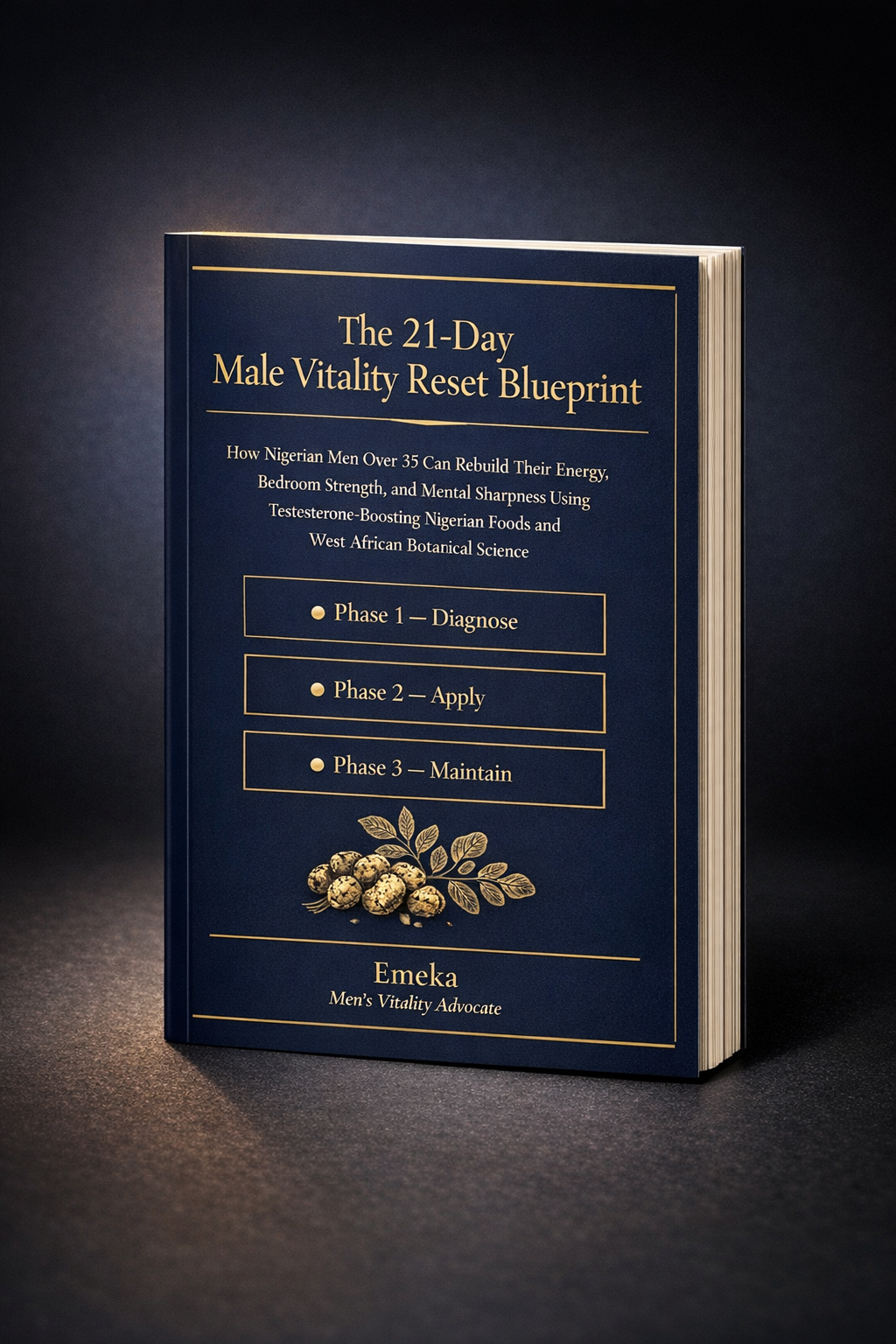
By mid-2024 I had shared the method with more men than I could personally guide one by one. The details matter too much — the exact preparation, the exact timing, the exact combinations — to trust to a voice note or WhatsApp message.
So I did what I had been reluctant to do for months.
I wrote every single detail down.
Secure checkout via Nestuge | Pay by card, bank transfer, or USSD | Instant delivery to your email
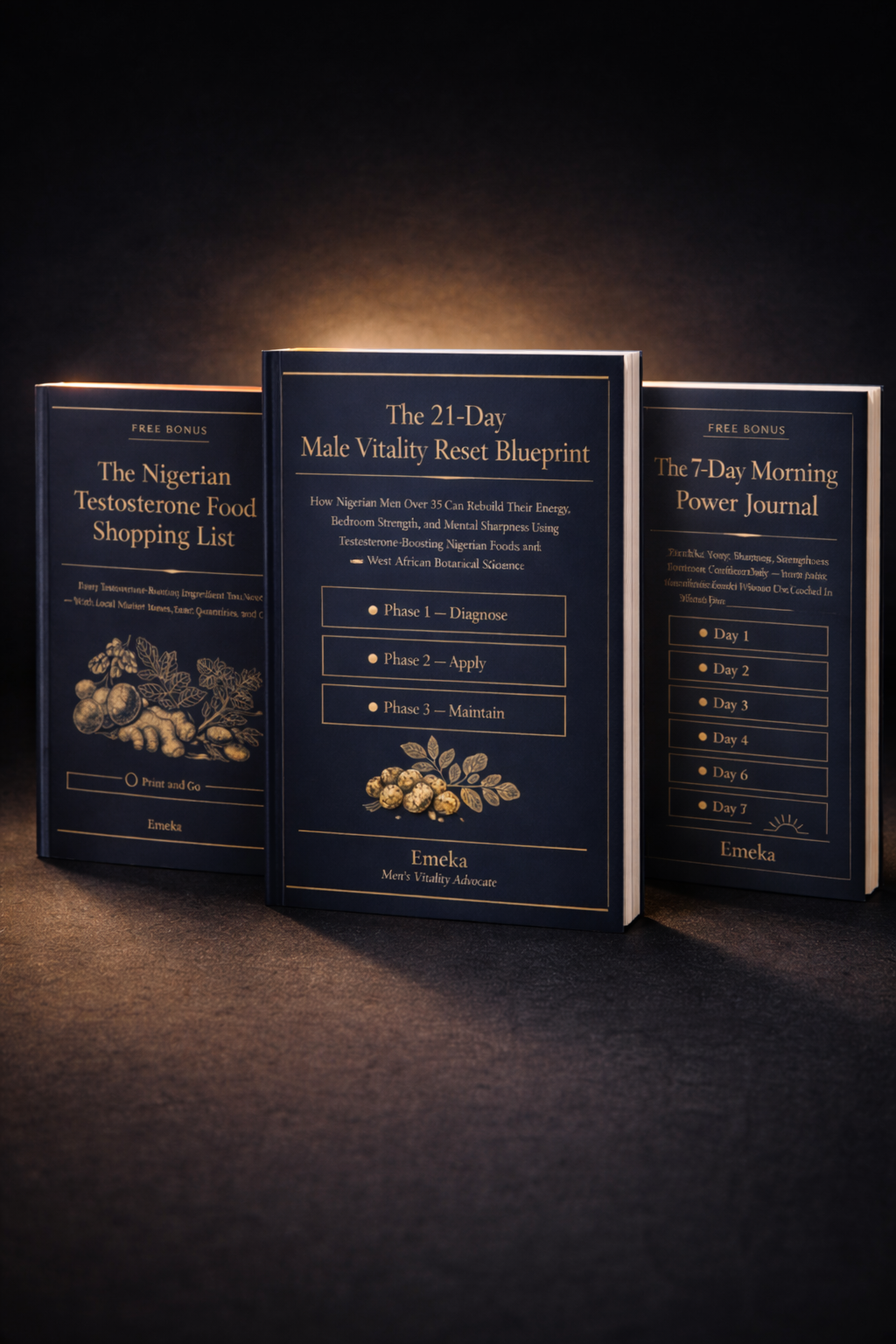
N9,800 one-time | Both bonuses included | First 30 buyers only | Instant delivery
N9,800 one-time | Instant digital delivery | 30-day money-back guarantee | Secure checkout via Nestuge