You know that feeling when the doctor finishes talking... and you realise you stopped hearing him five minutes ago?
He was still moving his lips. Something about HbA1c levels. Something about kidneys. Something about your blood pressure.
But the only word you heard — the one that stopped everything — was amputation.
"If this continues, the risk of amputation becomes very real."
You sat in that plastic chair in his office and smiled and nodded. Because that is what we do. We are Nigerian men. We do not show panic in front of a doctor.
But inside, your whole world shifted.
You drove home in silence.
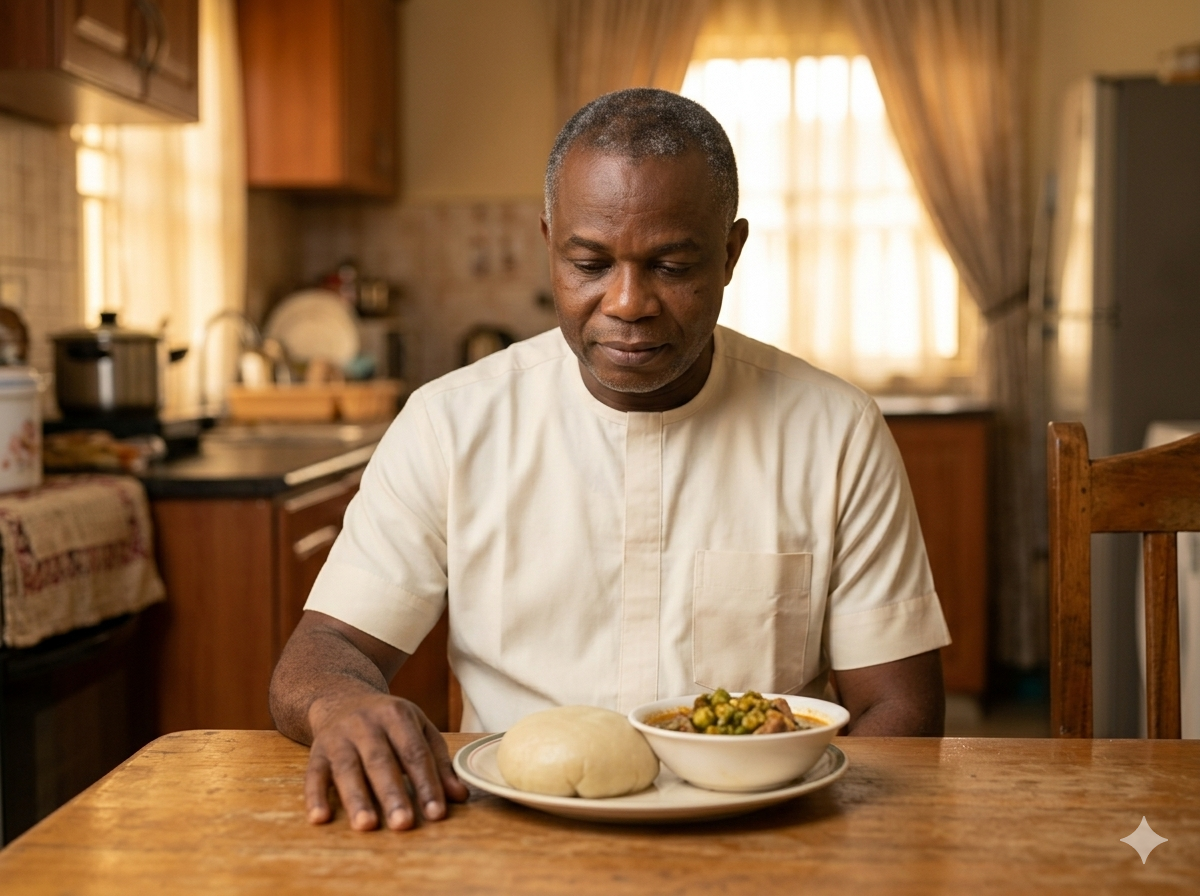
You sat at the dining table and your wife put a plate in front of you — eba and egusi, the same soup she has been making for twenty years — and you stared at it like it was a weapon.
Am I supposed to stop eating this? Is this what is killing me?
Maybe you have already tried to change. You cut out sugar for two weeks. You bought the "diabetic diet" sheet the hospital gave you — brown rice, grilled chicken, cucumber salad.
You lasted four days.
This is not my food. This is oyibo food. Nobody in my family has ever eaten like this.
And the worst part? Even when you tried — even when you suffered through that bland, joyless eating — your sugar numbers barely moved.
So now you are stuck. Caught between a doctor who is telling you to change and a body that does not know how to live without the food that built it.
Your wife watches everything you eat now. Your children have started looking at you differently — that quiet, worried look that no man ever wants to receive from his children.
Christmas is coming. Naming ceremonies. Weddings. Tables full of jollof rice and fried chicken and pepper soup. And you will sit there counting your portions like a schoolboy while everyone else eats freely.
Is this what the rest of my life looks like? Is this who I have become?
I need you to stop what you are doing right now.
Drop everything and read every single word I am about to say.
Because what I am about to share with you changed everything for me — and it has nothing to do with giving up your food.
"Because I'm about to share with you a simple cooking method that allowed me — and over 200 Nigerian men I have quietly shared it with — to bring their blood sugar down without abandoning a single staple food."
Our grandfathers ate eba every day of their lives. Tuwo shinkafa. Pounded yam. Akpu. They ate this food from childhood to old age — and most of them never heard the word diabetes.
Something changed. And it was not the food itself.
It was how we prepare it. What we pair it with. When we eat it. What we have lost from the way our grandmothers used to cook.
This knowledge has been sitting in our culture all along. It just needed someone to write it down properly for the modern Nigerian man.
My name is Chidi.
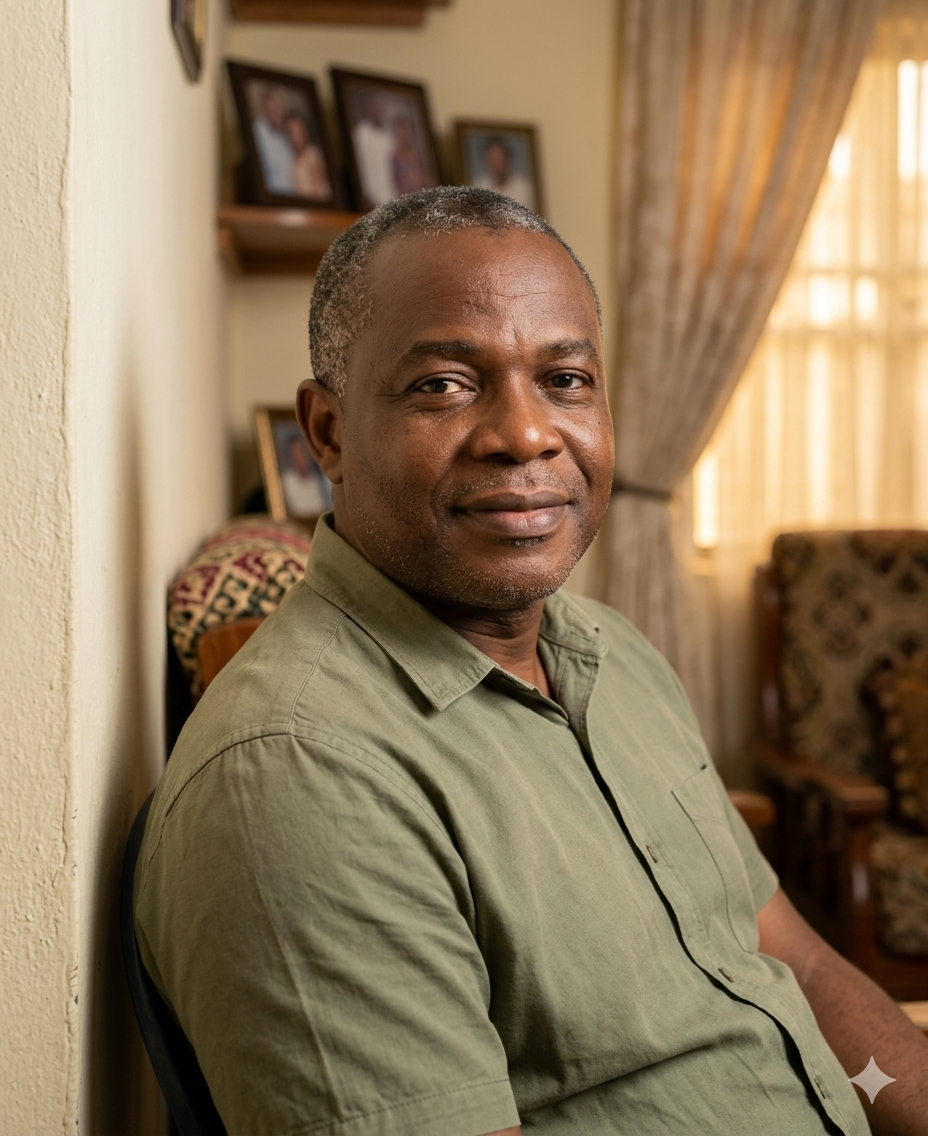
First thing you need to know about me — I am not a doctor. I am not a pharmacist or a dietitian or any kind of health professional. I am just a 51-year-old man from Enugu who was diagnosed with Type 2 diabetes three years ago and spent the next eighteen months nearly losing my mind trying to manage it.
What I found — through a retired UNTH dietitian named Mama Okafor, who I will tell you about in a moment — saved my health. And I believe it will save yours too.
My Story — How It Started, How It Almost Destroyed Me, and How I Found the Way Out
It started at a routine medical check at my office. I was not sick. I had no symptoms — or at least, none I was paying attention to. The fatigue I blamed on work. The frequent urination I blamed on too much water. The blurred vision I blamed on age.
The company doctor called me aside after the results came back.
"Chidi, your fasting blood glucose is 11.4. That is well above the diabetic threshold. We need to talk."
I drove home that evening and did not say a word to my wife at dinner. I sat in our living room until midnight Googling things I wish I had never read. Diabetic neuropathy. Diabetic retinopathy. Diabetic nephropathy. Every complication named after the same disease slowly dismantling a man from the inside.
I was 48 years old. I had a wife, three children, a business I was still building. I was not ready to become a sick man.
The emotional cost came fast.
My wife — God bless her — became my food police overnight. Every meal became a negotiation. She started buying things I had never seen in our kitchen. Low-GI bread. Oat biscuits. Brown rice imported from some online store in Lagos at four times the price of ordinary rice.
I ate it all without complaining. Because I was scared. And because she was scared too — I could see it in the way she watched me, the way she paused before she answered when I asked if something was "okay to eat."
But the intimacy between us quietly changed. I became a patient before I became a husband. There were nights I lay awake wondering — is this how the rest of our marriage looks? Me eating differently from my own children at Christmas?
One evening I overheard my eldest son on the phone with his cousin: "Papa is managing diabetes now. We are watching what he eats."
I sat in the corridor outside the room and felt something break quietly inside me.
I was the man who had carried this family. I had worked twenty years to put my children through school. And now, at the age I was supposed to be enjoying the rewards of that work — I was being managed.
That was my breaking point.
I called my older sister that night and broke down on the phone. She listened without interrupting. When I finished, she said something that has stayed with me:
"Chidi, the problem is not the food. The problem is that nobody has taught you how to eat the food you were born to eat. Our grandfather ate this same food. He never had diabetes. Something changed between his time and ours — and it is not the eba."
She was right. But I did not know what had changed. Or how to find out.
So I started trying everything.
- The hospital diabetic diet sheet — brown rice, grilled chicken, vegetable salad. I lasted five days before I abandoned it. No Nigerian man raised on pounded yam can sustain this diet long-term. It is not practical. It is not cultural. It does not work for how we actually live.
- Metformin (prescribed medication) — I took it consistently for eight months. My numbers improved slightly but never reached safe levels. The stomach cramps were unbearable. After several months I began to skip doses just to get through the day.
- Bitter leaf juice every morning — A colleague at work swore by it. I drank it for six weeks. My blood sugar barely moved. My wife found the bottle and asked why I smelled like a bush medicine market.
- Cutting out all carbohydrates completely — I tried this for three weeks based on something I read online. I lost a little weight but my energy collapsed entirely. I could not function at work. My doctor told me this approach was dangerous for my type of diabetes.
- Herbal capsules from a vendor on Instagram — I spent ₦35,000 on a two-month supply after seeing testimonials that looked convincing. By the fourth week I realised the "testimonials" were stock photos. My glucose readings after two months were exactly where they had been before.
- Portion control alone (eating less of the same food) — I was advised to "just eat less." I did. I was hungry every three hours. My mood was destroyed. My work suffered. And my numbers did not improve significantly enough to justify the suffering.
By the end of eighteen months, I had spent over ₦180,000 on solutions that did not work. My numbers were marginally better but nowhere near where they needed to be. My doctor was beginning to talk about insulin injections.
I was exhausted. And I was starting to quietly accept that this disease would define the rest of my life.
Then I met Mama Okafor.
It was at my cousin's child's naming ceremony in Awka. One of those large family events where every table has its own conversation going, and you end up seated next to someone you have never met before.
I was sitting cautiously in front of my small plate — watching everyone else eat freely while I counted portions — when the elderly woman beside me leaned over and said quietly:
"You have diabetes, abi? I can see by how you are looking at that jollof rice like it owes you money."
I laughed for the first time in months.
Her name was Mrs. Ngozi Okafor. Retired senior dietitian from the University of Nigeria Teaching Hospital, Enugu. Thirty-two years in clinical nutrition. She had spent the last decade of her career specifically studying how Nigerian traditional foods interact with blood sugar — before she retired and moved back to her village in Anambra.
I told her everything. The failed diet sheets. The herbal capsules. The Metformin. The blood sugar readings that refused to come down to a safe level.
She listened. Then she shook her head slowly.
"Every solution you tried was designed for a Western body eating Western food. None of those people sat down and studied eba. None of them looked at how egusi soup is made. They took research done on bread and pasta and told you to apply it to pounded yam. That is why nothing worked."
She told me something that night that no doctor had ever told me in three years of treatment.
"The glycaemic impact of Nigerian food is not fixed. It changes completely depending on how you prepare it, what you eat it with, and the order in which you eat different things on your plate. Your eba is not the problem. The problem is that nobody ever taught you how to eat it properly as a diabetic."
She spent the next two hours — between bites of the very food I had been avoiding for eighteen months — explaining everything to me. The science behind it. The traditional practices our grandmothers used without knowing the science. The specific changes I needed to make.
She called it "eating Nigerian the smart way."
I will be honest — my first reaction was scepticism. If the solution is this simple, why has no doctor told me this in three years?
But I was desperate enough to try anything. So I went home and made the three changes she described. Starting with my very next meal.
The first four days — nothing obvious. My readings were similar to before. I almost stopped.
On Day 6, I checked my fasting blood glucose in the morning as usual. The number made me check the glucometer again. Then a third time.
It was the lowest reading I had recorded in three years.
I sat on the edge of my bed and did not move for several minutes.
By the end of week two, my post-meal readings — which had always been the most alarming numbers — were consistently within the safe range for the first time since my diagnosis.
I was eating eba. I was eating jollof rice. I was eating ofe onugbu. The same food my wife had been cooking for twenty years.
Just prepared and eaten differently.
Three weeks in, my wife came to sit beside me after dinner. She looked at my glucose diary — the little notebook I had been keeping obsessively — and her eyes went wide.
"Chidi... these numbers. They are good. These are actually good numbers."
"I know," I said.
"But you ate the same food as everyone today. You ate the same jollof. The same fried plantain—"
"I know," I said again.
She put her hand over mine and was quiet for a moment. Then she said: "I feel like I got my husband back."
I am not ashamed to tell you that I cried that night. A 51-year-old man who had not cried in years — sitting in his own bedroom crying because his blood sugar reading was finally normal.
At my next clinic appointment three months later, my doctor looked at my HbA1c result and leaned back in his chair.
"Whatever you are doing, keep doing it," he said.
That was the day I decided to write everything down.
Because I had four brothers. I had colleagues at work. I had uncles and cousins and church members — Nigerian men all managing the same disease with the same failed solutions. And none of them needed to go through what I went through for three years.
They just needed what Mama Okafor gave me: the knowledge of how to eat the food they were born to eat — without letting it kill them.
I started getting calls. Then WhatsApp messages. Then my wife's relatives. Then their neighbours. Then my own colleagues at work who had seen the change in me.
Everyone wanted to know what I was doing. And I was spending hours — every week — explaining it individually on the phone.
So I made a decision. I hired a professional writer. I worked with a nutritionist friend to verify the science. And I compiled everything — every detail, every food rating, every preparation switch, every Mama Okafor principle — into one simple, complete guide.
Introducing:
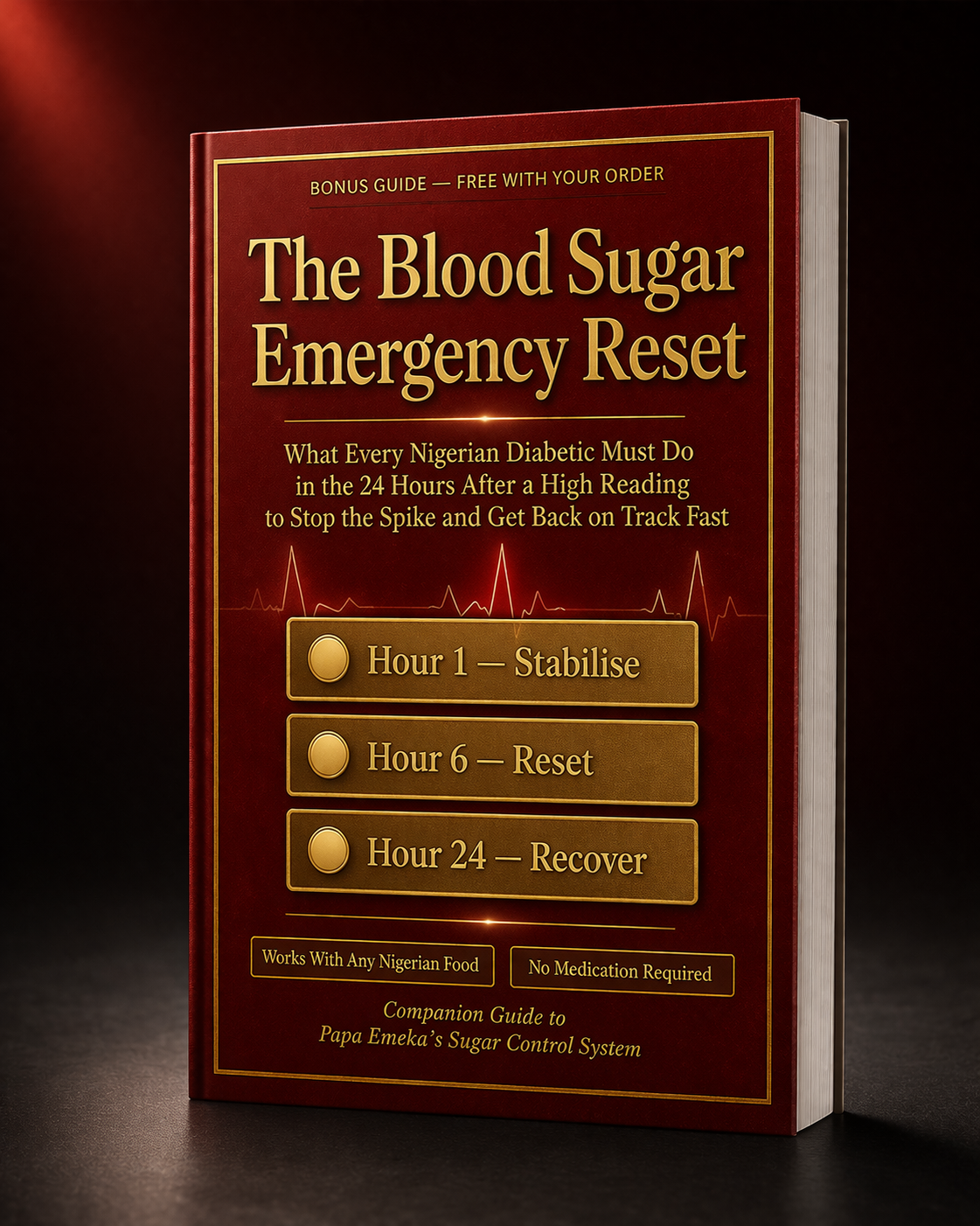
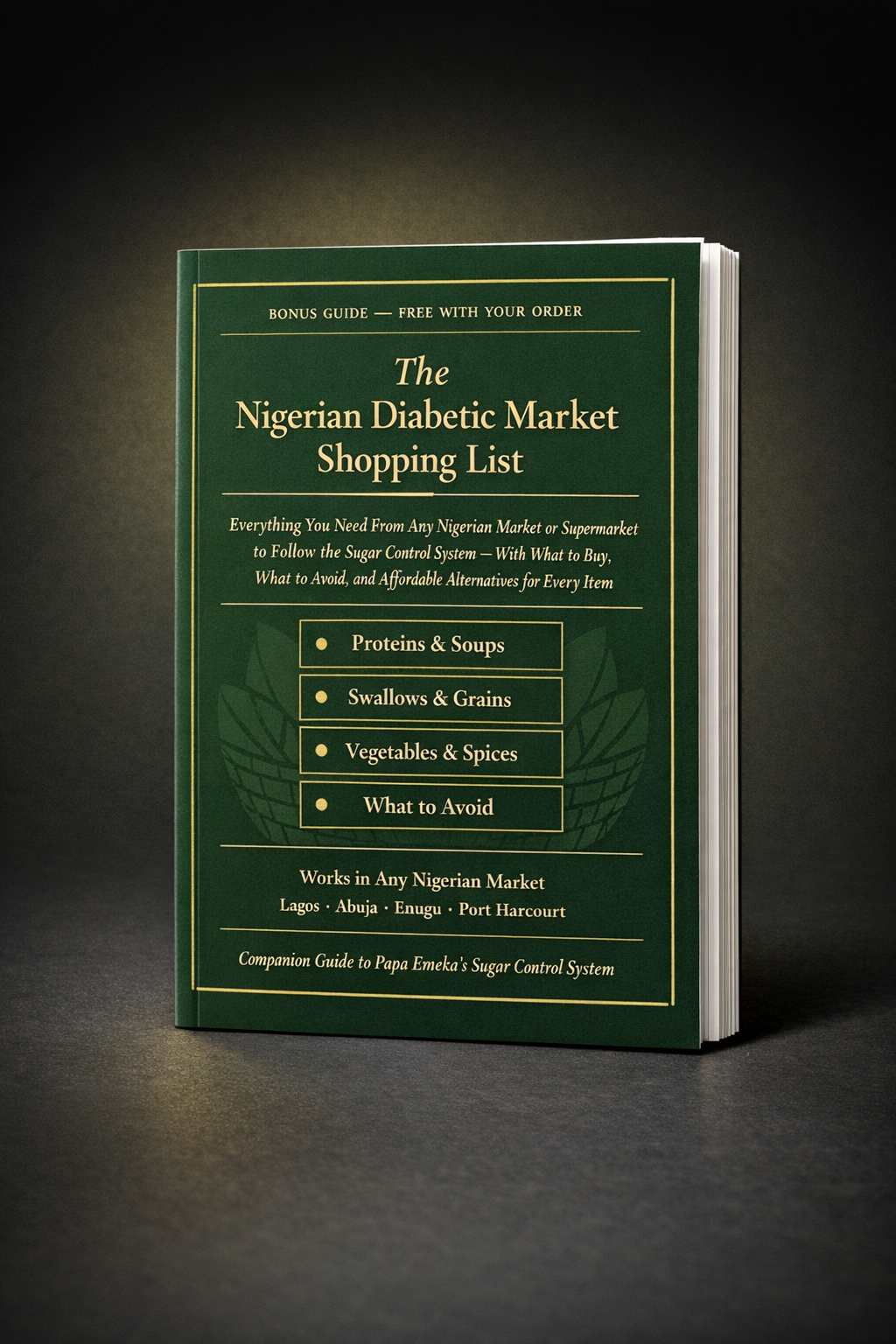
Papa Emeka's Sugar Control System
The Nigerian Man's Complete Guide to Controlling Diabetes Without Giving Up Eba, Rice, or the Food That Makes Life Worth Living


Share Your Experience