Mama Emeka's Sugar Control System | NaijaHealthTalk Blog
Whether your doctor has already warned you about your blood sugar, or you have simply been noticing that something in your body feels different — this was written for you.
NaijaHealthTalk Blog
Nigeria's Most Trusted Plain-Language Health Resource for Everyday Nigerians
HOME  |  WOMEN'S HEALTH  |  DIABETES  |  NATURAL REMEDIES  |  CONTACT

Retired UNTH Dietitian Reveals the Simple Cooking Switch That Helps Nigerian Women Control Their Blood Sugar — Without Giving Up Egusi Soup, Jollof Rice, or the Food They Have Been Cooking Their Whole Life

Adaeze — NaijaHealthTalk Blog

Adaeze — NaijaHealthTalk Blog

You know that moment when the doctor finishes talking... and you realise you stopped listening ten minutes ago?

He was still speaking. Something about HbA1c. Something about kidneys. Something about the progression of your condition if you do not make changes.

But the only word you caught — the one that made everything else go silent — was insulin.

"If your numbers do not improve, we will need to discuss starting insulin injections."

You sat in that plastic chair across from his desk and nodded. Because that is what Nigerian women do. We smile. We absorb. We do not fall apart in a doctor's office. We save that for later — for the car, for the kitchen, for the quiet hour after everyone is asleep.

You drove home. You stood at your stove and looked at the pot of egusi you had been making for 25 years — the same soup your mother taught you, the same soup your children ask for by name — and you felt something shift inside you.

Is this what I have to give up? Is this what is making me sick?

Maybe you had already tried to change things. The hospital gave you a diet sheet. You looked at it and looked at your kitchen and felt a specific kind of grief — the grief of a woman being told to abandon the food that has been her love language to her family for decades.

Brown rice. Oat porridge. Grilled fish with no pepper. Steamed vegetables.

This is not my food. Nobody in this kitchen has ever eaten like this. How am I supposed to cook this for my family?

You tried. Most Nigerian women do. You lasted a week, maybe two. Because you were scared. And then you went back to cooking what you know, because you had a family to feed and a life to manage and a house that does not run without you.

And the worst part? Even when you tried — even when you suffered through those bland, joyless meals — your blood sugar readings barely moved.

So now you are trapped. The doctor is warning you. The diet advice does not fit your kitchen. The numbers are not cooperating. And somewhere underneath all of it is the quiet, exhausting weight of managing this entirely alone — because Nigerian women manage everything quietly and we do not burden anyone with what we are carrying.

Your children have noticed something. The way you serve everyone a full plate and give yourself something different. The way you check your glucometer before you eat at Christmas. The way you look at the owambe table and calculate instead of celebrate.

Your husband has noticed. He does not know what to say, so he says nothing — except that occasional worried look across the dining table that you pretend you do not see.

And at church, at family gatherings, at every celebration where Nigerian women are supposed to eat freely and joyfully — you are there with your small careful plate, performing wellness, while the numbers on your glucometer tell a different story every morning.

Is this what the rest of my life looks like? Managing quietly. Eating separately. Watching everyone else eat the food I made?

I need you to stop what you are doing right now.

Read every word I am about to say. Because what I am about to share changed everything for me — and it has nothing to do with giving up your food.


"Because I am about to share with you a simple cooking method that allowed me — and over 200 Nigerian women I have quietly shared it with — to bring our blood sugar down without abandoning a single ingredient in our kitchens."

Our grandmothers cooked egusi soup every day of their lives. They made eba, pounded yam, jollof rice — they fed their families with these foods from marriage to old age. And most of them never once heard the word diabetes in relation to themselves.

Something changed between their kitchen and ours. And it was not the food itself.

It was how we prepare it. What we pair it with. When we eat things and in what order. The small preparation habits our grandmothers practised without knowing the science — habits that have slowly disappeared from modern Nigerian kitchens.

This knowledge has been sitting in our culture all along. It just needed someone to write it down in a way that a Nigerian woman managing a household and a health condition could actually use.

My name is Adaeze.

The first thing you need to know about me — I am not a doctor. I am not a dietitian or a pharmacist or any kind of health professional. I am a 49-year-old woman from Enugu who was diagnosed with Type 2 diabetes two years ago and spent the next eighteen months nearly losing my mind trying to manage it while continuing to cook for my family and run my household.

What I found — through a retired UNTH nutritionist named Mama Okafor — saved my health. And I believe it will save yours too.


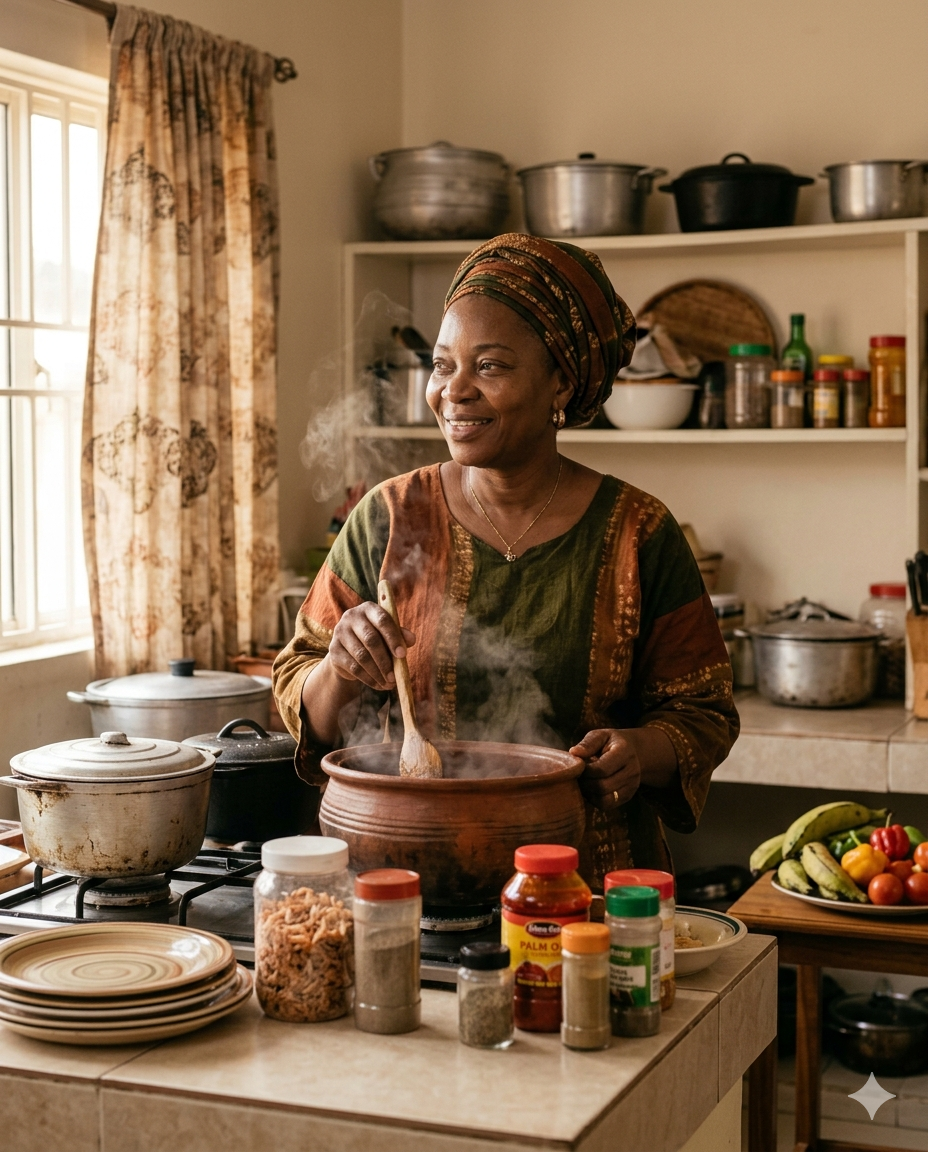
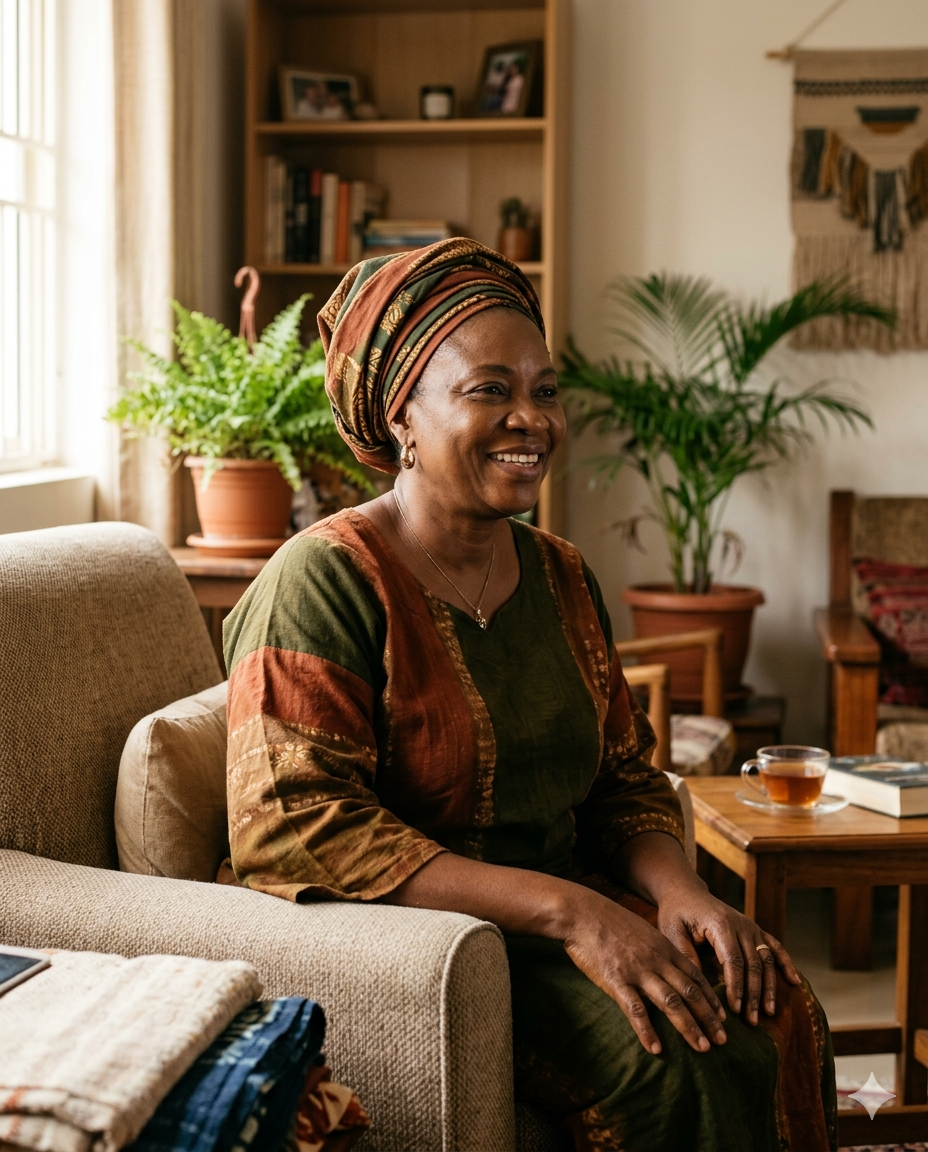
Adaeze in her kitchen

Adaeze in her kitchen — the woman who found the answer

My Story — How It Started, How It Quietly Destroyed My Kitchen, and How I Found My Way Back

It started at a routine blood pressure check at my doctor's clinic. I had gone in for something minor — a follow-up on my blood pressure medication. I was not worried. I had no obvious symptoms, or at least none I had connected to anything serious.

My doctor asked for a fasting blood glucose test as part of a general check-up. I did not think much of it. I had done these before. The results had always come back normal.

She called me back into her office two days later.

"Adaeze, your fasting blood glucose is 10.8. That is well above the diabetic threshold. We need to talk about what happens next."

I drove home and sat in my car outside my own house for fifteen minutes before I could go inside.

My youngest was still in school. My husband was at work. The house was quiet. I sat at my kitchen table — the same table where I have cooked and served and fed this family for twenty-two years — and Googled things I wish I had never read. Diabetic neuropathy. Diabetic retinopathy. Diabetic nephropathy. Each one named after the same disease slowly working through a body.

I was 47 years old. I had children to raise. A household to manage. A kitchen that nobody else in this family could run. I could not afford to be sick.

The hardest part was not the diagnosis. It was what happened to my kitchen afterwards.

I tried the hospital diet sheet first. Brown rice imported from a Lagos health store at four times the price of ordinary rice. Grilled fish with no pepper. Steamed vegetables. Oat porridge every morning.

I lasted twelve days. Not because I lacked willpower. Because I was cooking two completely separate meals every evening — one for my family and one for myself. And I was watching my children eat what I had made for them while I sat in front of something that had nothing to do with my life.

My daughter asked me one evening why my food always looked different from everyone else's. I could not answer her. She was eight years old. She did not need to understand Type 2 diabetes. She just needed to know why her mother — the woman who cooked for everyone in this house — was eating something that looked like punishment.

I put down my spoon. I sat there for a moment. Then I quietly got up and threw the hospital diet sheet in the bin.

So I started trying everything else.

  • The hospital diabetic diet sheet — Brown rice, grilled chicken, steamed vegetables, oat porridge. Lasted twelve days. Numbers improved by almost nothing. My family could see I was suffering. I abandoned it and felt like a failure for three weeks afterwards.
  • Bitter leaf juice every morning — My neighbour swore her uncle's diabetes was controlled by drinking bitter leaf juice on an empty stomach for three months. I tried it for eight weeks. My blood sugar moved by 0.4 points. The smell made my children leave the kitchen every morning. I stopped.
  • Herbal capsules from a vendor on Instagram — I spent ₦38,000 on a two-month supply after reading testimonials that seemed convincing. By the fifth week I discovered the testimonial photos were stock images. My readings after two months were exactly where they had been before I started.
  • Cutting out all carbohydrates completely — Three weeks of no eba, no rice, no yam. I was cooking these foods for my family every day and eating boiled eggs alone. My energy collapsed. My temper shortened. My doctor told me this approach was dangerous for my specific type of diabetes. I stopped and felt worse for having tried.
  • Portion control only — eating less of everything — I reduced every portion across the board. I was hungry every two hours. I was irritable in the evenings. My husband asked me if something was wrong. My numbers improved slightly — not significantly enough to justify what I was going through every day.
  • A private nutritionist consultation — ₦25,000 — She gave me a meal plan. It was thoughtful. It was also designed for someone who eats bread and salad and has never made a pot of egusi soup in her life. I followed it for three weeks and then quietly stopped because it was not compatible with cooking for a Nigerian family on a daily basis.

By the end of eighteen months I had spent over ₦160,000 on solutions that did not work. My fasting numbers were marginally better but nowhere near the safe range. My doctor was beginning to use the word insulin in our conversations.

I was exhausted in a way that had nothing to do with the diabetes itself. I was exhausted from managing quietly. From pretending at church that everything was fine. From looking at my kitchen — the room that used to be my favourite place in this house — and feeling a faint anxiety every time I entered it.

My kitchen had stopped being a place of love. It had become a place of management. A place of calculation. A place where I cooked for everyone else's joy and then negotiated my own meal in secret.

That was my breaking point.

I called my older sister one night after everyone was asleep and broke down on the phone. She listened without interrupting. When I finished, she said something I have not forgotten:

"Adaeze, our grandmother cooked egusi soup every day of her life. She never had diabetes. Our mother cooked the same food. Something changed between their kitchen and yours — and I do not believe it is the egusi."

She was right. But I did not know what had changed. Or how to find out.

Then I met Mama Okafor.

It was at a naming ceremony in Awka — one of those large family events where every table is full and the conversations overlap across the room. I was doing what I always do at celebrations now — sitting carefully in front of a restricted plate, watching everyone else eat freely, calculating.

The elderly woman seated beside me watched me for a while. Then she leaned over and said quietly:

"You have sugar, abi? I can see by how you are looking at that jollof like it owes you an apology."

I laughed for the first time in what felt like months.

Her name was Mrs. Ngozi Okafor. Retired Senior Dietitian from the University of Nigeria Teaching Hospital, Enugu. Thirty-two years in clinical nutrition. She had spent the last decade of her career specifically studying how Nigerian traditional food interacts with blood sugar at a biological level — before she retired and moved back to Anambra.

I told her everything. The failed diet sheets. The herbal capsules. The bitter leaf juice. The private nutritionist who gave me a meal plan for a different person's kitchen. The blood sugar readings that refused to cooperate.

She listened. Then she shook her head slowly.

"Every solution you tried was designed for a Western body eating Western food. None of those people sat down and studied egusi soup. None of them looked at how eba is prepared. They took research done on bread and pasta and brown rice and told you to apply it to pounded yam and ofe onugbu. That is why nothing worked. The research was never done on our food."

She told me something that night that no doctor had told me in two years of treatment.

"The glycaemic impact of Nigerian food is not fixed. It changes completely depending on how you prepare it, what you eat it with, and the sequence in which different things arrive in your stomach. Your egusi soup is not your problem. The problem is that nobody has ever taught you how to cook it in a way that protects your blood sugar. The knowledge existed in our grandmothers' kitchens. It just was not written down."

She spent the next two hours — between bites of the celebration food I had been avoiding for eighteen months — explaining everything to me. The science behind resistant starch. How the soup-first eating sequence changes blood sugar response. How the ratio of soup to swallow on the plate determines the glycaemic impact of the entire meal.

She called it "eating Nigerian the smart way."

My first reaction was scepticism. If the solution is this simple, why has no doctor told me this in two years?

But I was desperate enough to try. I went home and made the three changes she described — starting with my very next meal. The same egusi soup. The same eba. Just prepared and eaten differently.

The first five days — my readings were similar to before. I almost stopped.

On Day 7, I checked my fasting blood glucose in the morning. The number made me check the glucometer again. Then a third time.

It was the lowest reading I had recorded since my diagnosis.

I sat on the edge of my bed and did not move for several minutes.

By the end of week two, my post-meal readings — which had always been the most alarming numbers — were consistently within the safe range for the first time in two years.

I was eating egusi soup. I was eating eba. I was eating the same food I had been cooking for my family all along.

Just prepared and eaten differently.

Three weeks in, my daughter came and sat beside me after dinner. She looked at my plate — a full plate, the same as everyone else's. She said nothing for a moment. Then:

"Mummy... your food looks like ours now."

"Yes," I said.

She leaned her head against my arm. That was all. She did not understand what had changed. She just knew that her mother was sitting at the table and eating with the family again.

I will not pretend I did not cry that night.

At my next clinic appointment three months later, my doctor looked at my HbA1c and leaned back in her chair.

"Adaeze — whatever you are doing, keep doing it," she said.

That was the day I decided to write everything down.

Because I had sisters managing the same condition alone. I had women from my church fellowship eating separately from their families at every gathering. I had cousins in Lagos and Birmingham and Toronto — Nigerian women managing diabetes with the same failed solutions, carrying the same quiet exhaustion, cooking for their families while eating differently and pretending everything was fine.

None of them needed to go through eighteen months of what I went through. They just needed what Mama Okafor gave me: the knowledge of how to cook the food they were born to cook — without letting it work against their health.


Women started calling me. Then WhatsApp messages from people I had never met — friends of friends, cousins of cousins, women from church groups who had heard something had changed for me. I was spending hours every week explaining the method individually on the phone.

So I made a decision. I worked with a professional writer and a nutritionist to verify every detail. And I compiled everything — every preparation switch, every food rating, every Mama Okafor principle — into one complete, clear guide built specifically for the Nigerian woman in her own kitchen.

Introducing:
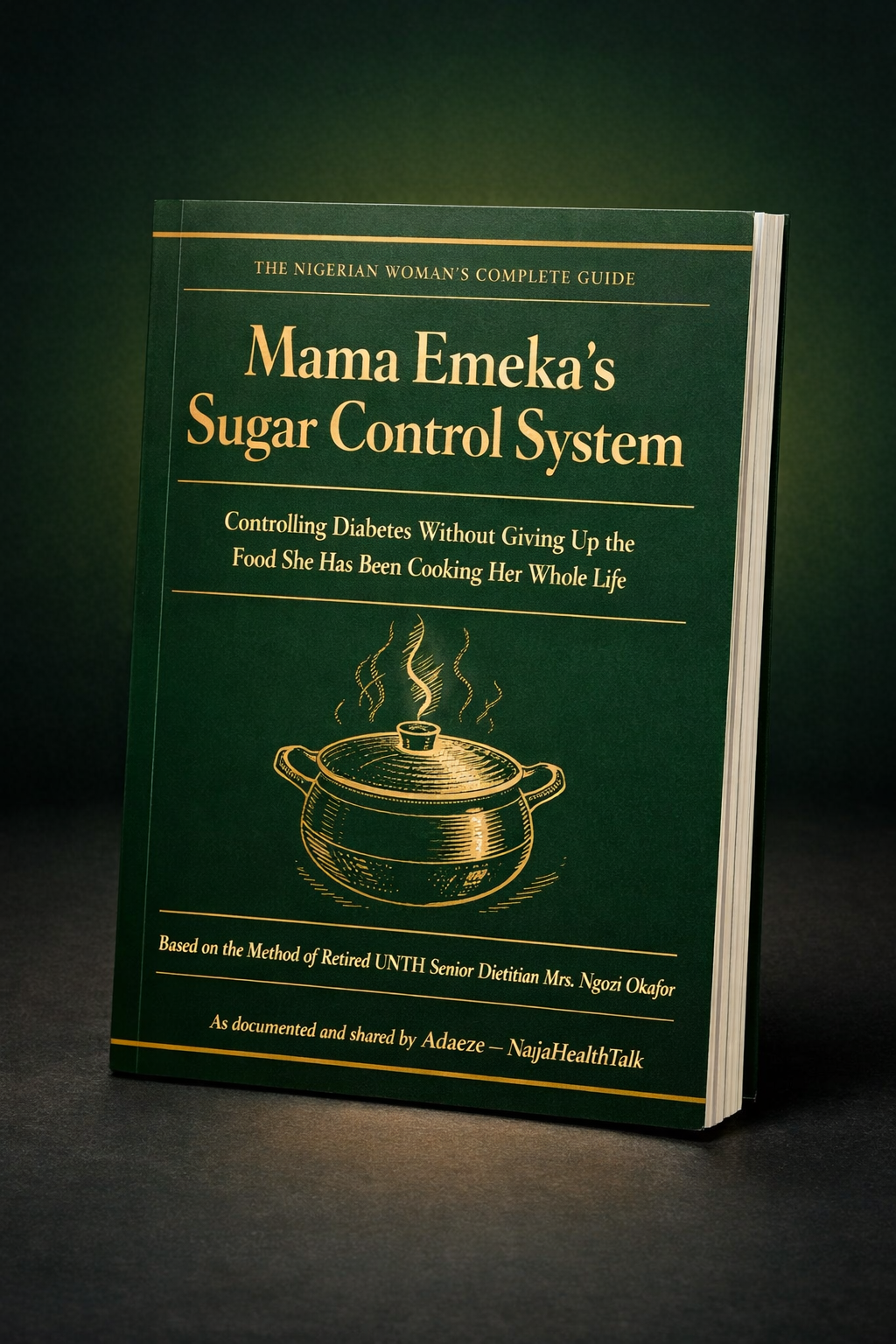
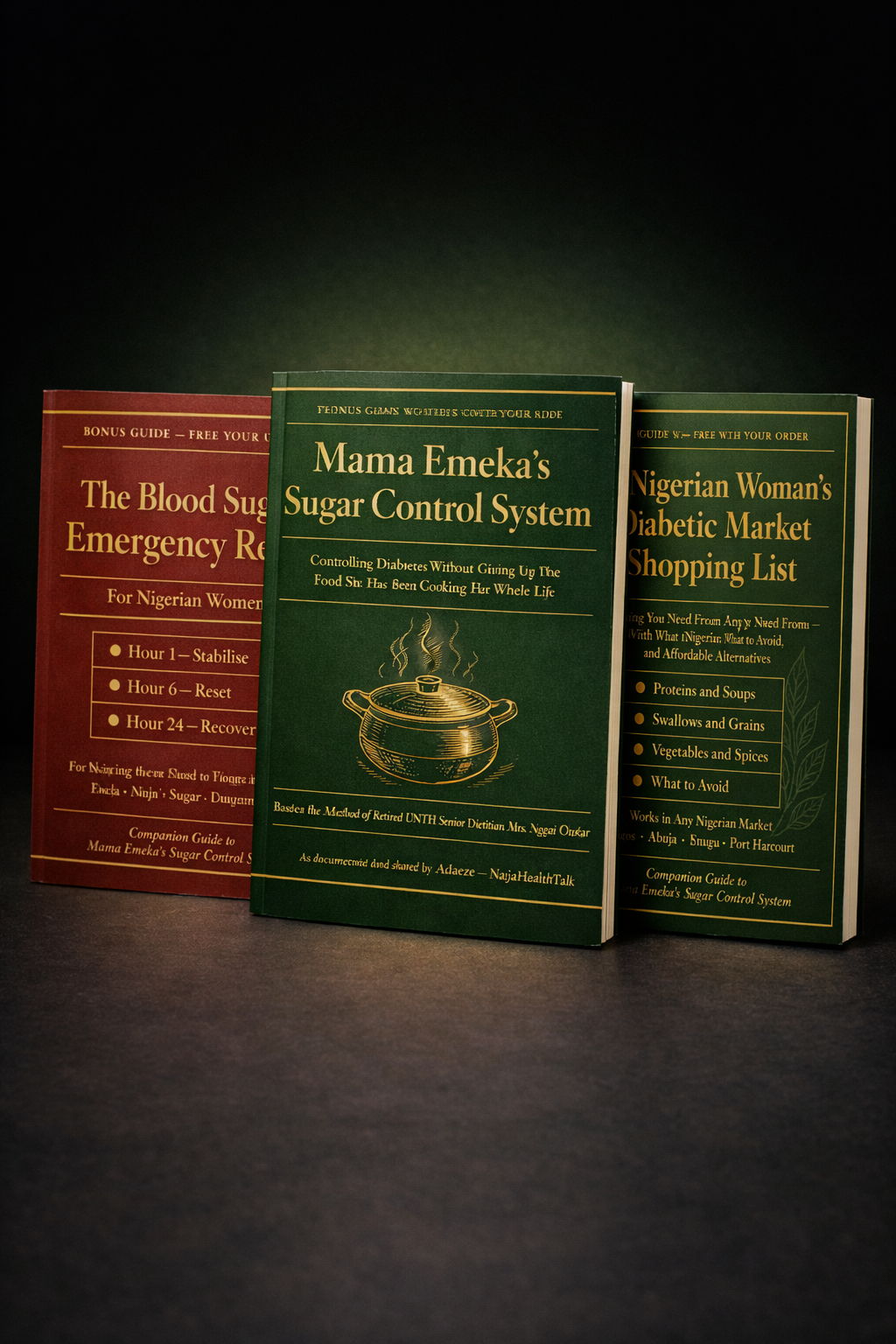
Mama Emeka's Sugar Control System
The Nigerian Woman's Complete Guide to Controlling Diabetes Without Giving Up the Food She Has Been Cooking Her Whole Life
Mama Emeka's Sugar Control System — PDF Guide

Here Is Exactly What Is Inside This Guide:

  • The 3 Preparation Switches That Change Everything — Three specific changes to how you prepare your Nigerian staple foods that reduce their blood sugar impact by up to 40%. These switches apply to the same food you are already cooking. Your family will not notice a single thing changed. — Pg. 3
  • The Nigerian Food Glycaemic Index — A complete rating of 40+ Nigerian foods — egusi, ofe onugbu, jollof rice, eba, pounded yam, ofada rice, moi moi, pepper soup, and more — showing exactly how each one affects blood sugar and what preparation changes make each one safer. — Pg. 8
  • The 8-Week Nigerian Diabetic Eating System — A full two-month meal plan using only foods available in any Nigerian market. One meal for the whole family — never two separate meals again. — Pg. 17
  • The Celebration Eating Guide — How to eat at owambe parties, Christmas, naming ceremonies, and family gatherings without destroying your progress — and without ever sitting in front of a restricted plate while everyone else eats what you cooked. — Pg. 31
  • The 10-Minute Daily Movement Protocol — A simple movement plan requiring no gym and no equipment — specifically designed for Nigerian women aged 40+ who manage a household and do not have time for a conventional exercise routine. — Pg. 36
  • "What Your Numbers Mean" Plain-Language Guide — A clear explanation of every blood sugar reading — fasting, post-meal, HbA1c — in plain language, with target ranges and exactly what to do when your number is higher than expected. — Pg. 41
  • The Doctor Visit Preparation Checklist — Exactly what to track, what to bring, and what questions to ask at your next clinic appointment so your doctor can see and understand your progress. — Pg. 45
  • The Family Cooking Integration Guide — How to apply the preparation switches to the food you already cook for your husband and children — so the whole household eats one meal and only your glucometer knows anything changed. — Pg. 49

And the most important part? You do not need to stop cooking your family's food. You do not need to buy foreign ingredients. You do not need to eat separately from your husband and children ever again. This is the same method that worked for me — and has now worked quietly for over 200 Nigerian women I have shared it with, from Lagos to Birmingham to Toronto.

Real Nigerian Women. Real Results. Real Testimonials.

Showing 5 of 43 testimonials  |  Verified buyers

CN
Chidinma Nwosu
🇳🇬 Enugu, Nigeria
3 days ago
★★★★★

I have been cooking for my family for 22 years. After my diagnosis I started making two different meals every evening — one for them and one for me. This guide ended that completely. I now cook once. My plate looks like everyone else's. My fasting number dropped from 9.6 to 6.8 in six weeks. My daughter asked why I stopped making my "sick food." I nearly cried when she said that.

FA
Funke Adeyemi
🇳🇬 Lagos, Nigeria
1 week ago
★★★★★

What I appreciate most about this guide is that it understands I am a Nigerian woman who cooks for a family every day. Every other diabetes resource I have seen talks about foods I have never bought in my life. This one talks about egusi, eba, jollof — my actual food. The preparation switches are simple. My HbA1c at my last appointment was 6.9, down from 9.2 when I started. My doctor is asking what changed. I just smiled.

AO
Amaka Okonkwo
🇬🇧 Birmingham, UK
2 weeks ago
★★★★★

I am Nigerian living in Birmingham managing diabetes with NHS advice that has nothing to do with how I cook. The NHS keeps telling me to eat things that are simply not in my kitchen. This guide is the first thing I have found that actually understands a Nigerian woman's relationship with her food. The preparation switches work in my Birmingham kitchen exactly as they would in Nigeria. My numbers have been in range for three months straight.

BI
Blessing Ibrahim
🇳🇬 Abuja, Nigeria
3 weeks ago
★★★★★

My mother has been managing diabetes for 9 years. I bought this for her after she told me she had been eating separately from the family at every meal for two years. She followed the meal plan for 8 weeks. Her doctor reduced one of her medications at her last visit — the first time that has happened in 9 years. She called me to say she ate with the whole family at Christmas for the first time in years. Buy this for your mother if she will not buy it for herself.

TO
Toyin Ogundimu
🇨🇦 Toronto, Canada
1 month ago
★★★★★

Managing diabetes as a Nigerian woman in Toronto is its own special challenge. I cook Nigerian food at home because it is the food my children know. Every diabetes resource here is designed for Canadian food. This guide finally gives me the science behind my own kitchen. My fasting number went from 10.1 to 6.4 in 10 weeks. Worth every naira and more. Every Nigerian woman in the diaspora managing this needs to read it.

... and 38 more reviews

Share Your Experience

Just So You Know... Putting This Guide Together Cost Me Over ₦185,000

  • Professional medical writer to research and write the content — ₦60,000
  • Nutritionist consultation and content verification — ₦45,000
  • Graphic designer for layout and PDF formatting — ₦30,000
  • Website, hosting, and delivery platform setup — ₦25,000
  • Testing and feedback rounds with 12 volunteer women reviewers — ₦25,000
I am not going to charge you ₦185,000...
Not even ₦50,000...
Not even ₦25,000...
You will not even pay ₦15,000...

A fair price for everything inside this guide would honestly be ₦19,800. But because I want this in the hands of every Nigerian woman who needs it — right now, before complications that could have been prevented set in:

₦19,800 ₦9,800 One-time payment. Instant download. No subscription.
⚡ This Discounted Price is ONLY For the First 50 Buyers — After That, Price Returns to ₦19,800
✅ Click Here to Get Mama Emeka's Sugar Control System NOW — ₦9,800 Only

🔒 Secure Checkout via Nestuge  |  Pay by Card, Bank Transfer, or USSD  |  Instant Download After Payment

⚡ WAIT! I Have FREE Gifts For You...

If you are among the FIRST 50 buyers, you will receive these two powerful bonuses alongside your guide — TODAY ONLY

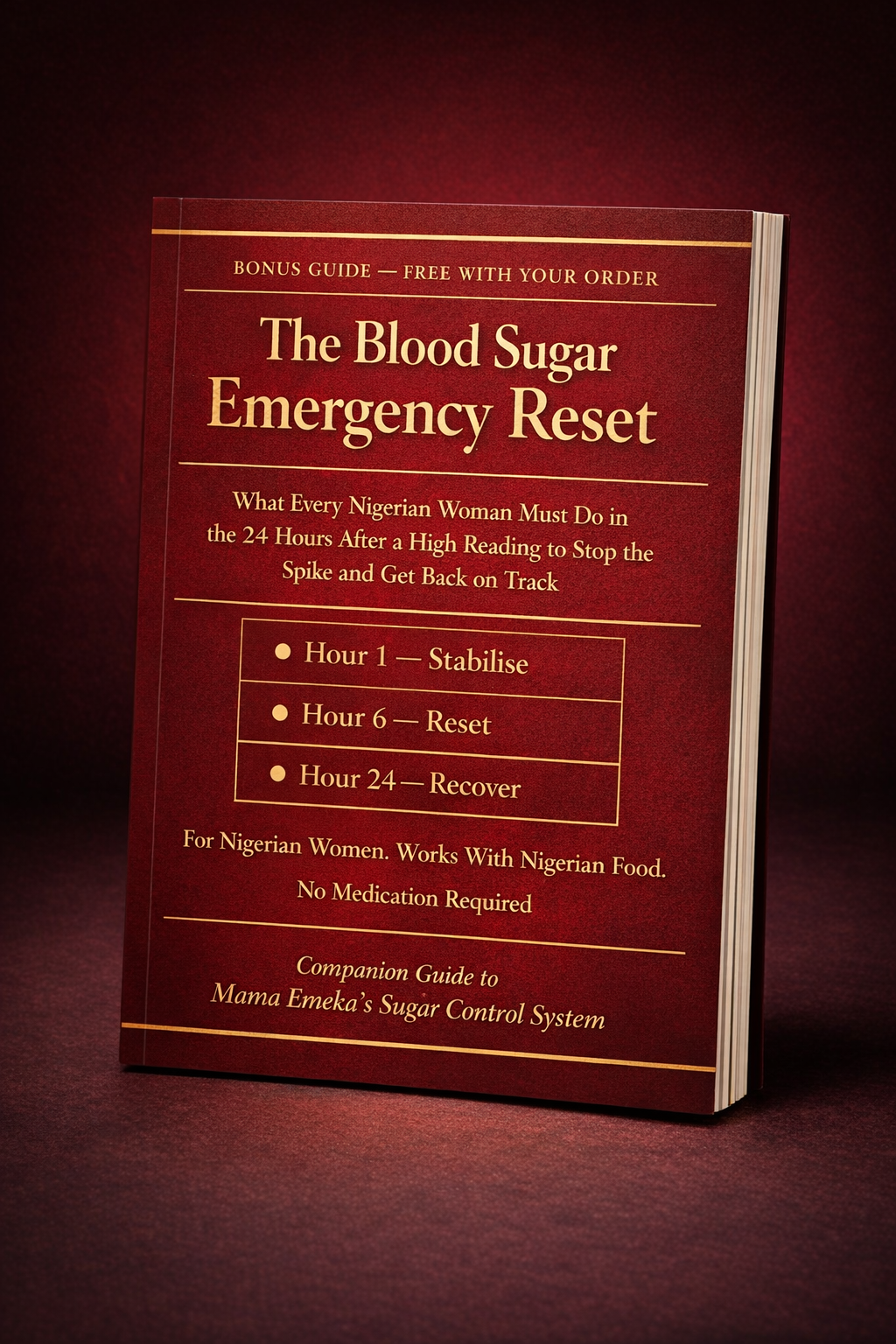
The Blood Sugar Emergency Reset For Nigerian Women

BONUS 1: The Blood Sugar Emergency Reset — For Nigerian Women

What to do in the 24 hours after a high reading — a quick-action protocol for Nigerian women when your numbers spike after a celebration meal, a stressful day, or a dietary slip. Stops the panic and gets you back on track fast.

Value: ₦5,000 — Yours FREE today

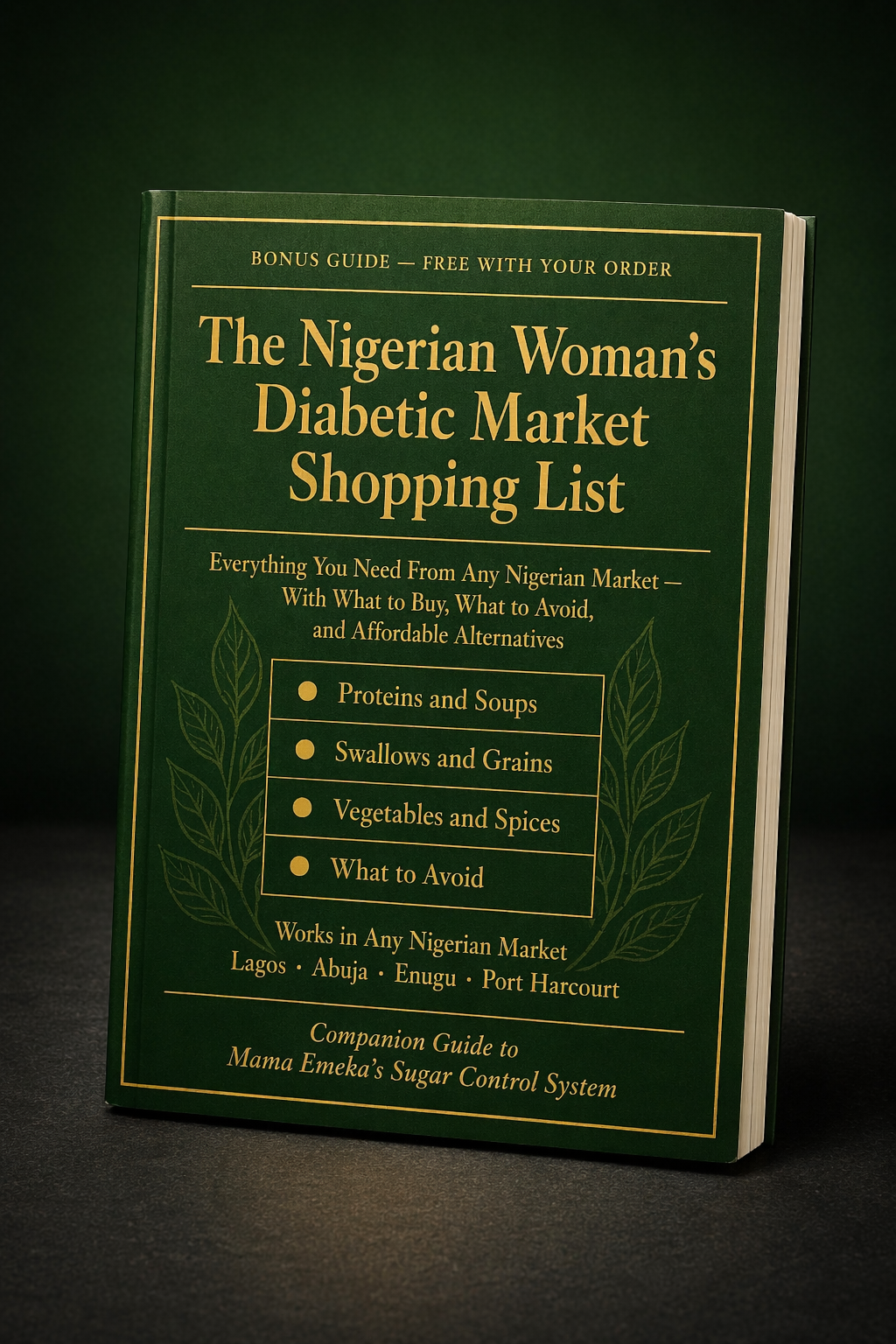
The Nigerian Woman's Diabetic Market Shopping List

BONUS 2: The Nigerian Woman's Diabetic Market Shopping List

A printable, ready-to-use shopping list of everything you need from any Nigerian market or supermarket to follow the Sugar Control System — with what to look for, what to avoid, and affordable alternatives for every item. Works from Lagos to Birmingham.

Value: ₦3,500 — Yours FREE today

Complete Bundle — Mama Emeka's Sugar Control System + Both Bonuses

Everything you get today — Main Guide + 2 FREE Bonuses

🎁 Click Here to Get Mama Emeka's System NOW + FREE Bonuses!

⚡ Limited to First 50 Buyers Only  |  Price Goes Back to ₦19,800 After

⚡ I'm Ready — Get Me In Before the Price Goes Up

Pay by Card, Bank Transfer, or USSD  |  Instant Access After Payment

Before You Decide — Let Me Answer the Three Questions You Are Probably Asking Right Now

❓ "Is this real? How do I know this is not another online product that will not work?"

I understand exactly why you are asking that. Nigerian women have been sold bitter leaf capsules, herbal teas, WhatsApp prayer group remedies, and imported supplements that did nothing — and most of us have spent money we cannot get back on things that were designed to take advantage of our desperation. So let me be completely direct with you.

This guide does not promise to cure your diabetes. It does not claim to replace your medication or your doctor. It teaches you one specific, verifiable thing — how to prepare and eat the Nigerian food you were already eating in a way that produces a measurably lower blood sugar response. That is not magic. It is nutritional science applied to Nigerian staple foods for the first time in a format any Nigerian woman can actually use in her kitchen tonight.

My real name is Boluwarin. My real email is coachboluwarin@gmail.com. My real WhatsApp number is +234 915 642 2131. If you have any issue after purchase — any issue at all — you reach a real person who stands behind this product completely. Not a bot. Not an automated response.

❓ "I have tried things before and they did not work. Why will this be any different?"

This is the most important question on this page and it deserves an honest answer.

Every solution you tried before — the hospital diet sheet, the herbal capsules, the carbohydrate cutting, the private nutritionist who gave you a plan for someone else's kitchen — was built for someone else. It was designed for a Western body eating Western food, or it was assembled with no scientific foundation at all and sold to you because you were scared enough to try anything.

Mama Emeka's Sugar Control System is structurally different in one fundamental way. It was built specifically around how Nigerian women cook and eat, what Nigerian food actually does to blood sugar at a biological level, and how to modify the preparation rather than eliminate the food entirely. The reason nothing else worked is not because you are resistant to change. It is because no solution has ever started where you actually are — at a stove making egusi soup for your family — and shown you exactly what to do from that exact point.

You did not fail those other solutions. Those solutions failed you. They were never designed for you in the first place.

❓ "Will this actually work for me — a woman who cooks for her entire household every day?"

If you are a Nigerian woman managing Type 2 diabetes or pre-diabetes, cooking Nigerian food for your family daily, and struggling to control your numbers using advice that was designed for someone else's kitchen — this system was built for your exact situation.

It has been used by Nigerian women in Lagos, Enugu, Abuja, and Port Harcourt. By diaspora Nigerian women in Birmingham, Toronto, and Houston managing the same impossible tension between their health and their food culture and their family's table. By women whose doctors were already talking about insulin injections — who brought their numbers down by changing how they prepared the same food they had always cooked.

The 3 Preparation Switches work regardless of which Nigerian staples you cook most — eba, pounded yam, jollof rice, ofada rice, egusi soup, ofe onugbu — because the underlying mechanism is about how your body processes starch and protein together, not which specific pot is on your stove.

And if for any reason it does not work for your specific situation — you have my personal 30-day money-back guarantee. Every naira returned. No questions. No delay. You are taking zero financial risk on this decision.

🛡️

My Personal 30-Day Money-Back Guarantee

Still feeling unsure? I completely understand. Which is why I am making you a bold, risk-free promise.

Download Mama Emeka's Sugar Control System today. Apply the 3 Preparation Switches to your very next meal. Follow the 8-Week Eating System for 30 days.

If you do not see a measurable improvement in your blood sugar readings — I will refund every single naira. No questions. No forms. No delay.

You have nothing to lose. Your health cannot afford more delay. And your kitchen deserves to become a place of love again — not a place of management.

✅ Yes — Get Mama Emeka's System Risk-Free for ₦9,800

More Real Results From Real Nigerian Women

Verified buyer testimonials  |  Updated weekly

KA
Kemi Adebisi
🇳🇬 Ibadan, Oyo State
5 days ago
★★★★★

The Nigerian Food Glycaemic Index inside this guide is worth ten times the price alone. I have been treating every Nigerian food like an enemy for two years. This guide showed me which ones are fine in the right quantities and which ones I was eating the wrong way. My post-meal readings have not gone above 7.8 in the past three weeks. This is progress I have not seen since my diagnosis.

NE
Ngozi Ezenwachi
🇳🇬 Owerri, Imo State
1 week ago
★★★★★

I cook for my husband and four children. After my diagnosis I was making two meals every single evening — one for the family and a small sad meal for myself. My youngest asked why my food was different. I did not know how to answer. I found this guide and applied the preparation switches. Four weeks later I was eating the same food as my family again. My fasting number went from 10.3 to 6.9. I am back in my kitchen properly.

RA
Rose Adesanya
🇳🇬 Lagos, Nigeria
2 weeks ago
★★★★★

I am a church woman. Every Sunday after fellowship we have a shared meal and I was always the one with the small different plate while everyone else ate properly. Adaeze's guide changed that for me. I now eat at every church meal. Full portions. My readings are still good the next morning. The women in my fellowship are now asking what I am doing differently. I have sent this link to four of them already.

MO
Maureen Obi
🇺🇸 Houston, USA
3 weeks ago
★★★★★

Living in Houston with Nigerian food habits is difficult enough. Managing diabetes here on top of that — with American doctors who have never heard of egusi soup — was making me feel completely alone in this. This guide is the first resource that speaks my food language entirely. I applied the preparation switches to my Houston kitchen and my numbers dropped significantly within two weeks. Every Nigerian woman in the diaspora managing this needs this guide.

GO
Grace Okeke (daughter, bought for mother)
🇳🇬 Abuja, Nigeria
1 month ago
★★★★★

My mother has been managing diabetes for seven years. She was always eating separately from the family at every gathering — Christmas, Easter, every owambe. I bought this for her. She read the whole thing in one sitting — she said it was the first diabetes resource she had ever read that understood she is a Nigerian woman who cooks. Six weeks later her doctor reduced one of her medications. I cried when she told me. God bless whoever made this.

You Now Have Two Choices.

✅ OPTION 1 — Take Action Today

Get Mama Emeka's Sugar Control System right now for ₦9,800. Apply the 3 Preparation Switches to your very next meal tonight. Cook one meal for your whole family — not two. Serve yourself the same plate as everyone else. Attend your next celebration without calculating every mouthful. Show up to your next doctor's appointment with readings that make her sit forward in her chair. Give your daughter a mother who eats at the table with confidence. Be fully present in your kitchen again — the kitchen that has always been yours.

✗ OPTION 2 — Close This Page

Go back to the same diet advice that has not worked. Keep cooking two separate meals every evening. Keep watching your family eat what you made while you eat something different. Keep sitting at celebrations with the restricted plate. Keep managing this alone and quietly while the numbers stay where they are. Keep hearing your doctor mention insulin at every visit. Maybe something will change on its own. Maybe.

Perhaps God put this page in front of you today for a reason. Nigerian women carry everything — our health, our kitchens, our families, our silence. You do not have to carry this one alone anymore.

This is your chance to do something different. ₦9,800. Thirty seconds to complete the payment. A lifetime of eating your own food safely at your own table.

⏰ The Clock Is Ticking. The Price Will Return to ₦19,800.
🔥 YES — Give Me Mama Emeka's Sugar Control System + Bonuses for ₦9,800 RIGHT NOW

🔒 Secure Payment  |  Card / Bank Transfer / USSD  |  Instant Download  |  30-Day Money-Back Guarantee

Questions? WhatsApp: +234 915 642 2131  |  Email: coachboluwarin@gmail.com