Real Stories • Real Nigerian Remedies • Real Results
Home • Health • Diabetes • Natural Remedies • Contact
Featured Health Discovery
Retired UNTH Dietitian Reveals How Nigerian Couples Are Using Bitter Leaf, Uziza and Scent Leaf — Combined With Three Kitchen Switches — to Bring Their Blood Sugar Down Without Giving Up Eba, Jollof, or Any Food That Makes Life Worth Living
By Emeka & Ngozi Obi • NaijaHealthTalk Blog • Health & Diabetes • 12 min read
I need you to read this slowly. Because what I am about to tell you is not what the hospital told you. Not what Google told you. And definitely not what the bitter leaf capsule vendor on Instagram told you.
It is what a 63-year-old retired UNTH Senior Dietitian told me and my wife — at a naming ceremony in Awka, between bites of the exact food I had been afraid to eat for two years — when she looked at us and said quietly:
"Your food is not your enemy. Your ignorance of how to prepare it is."
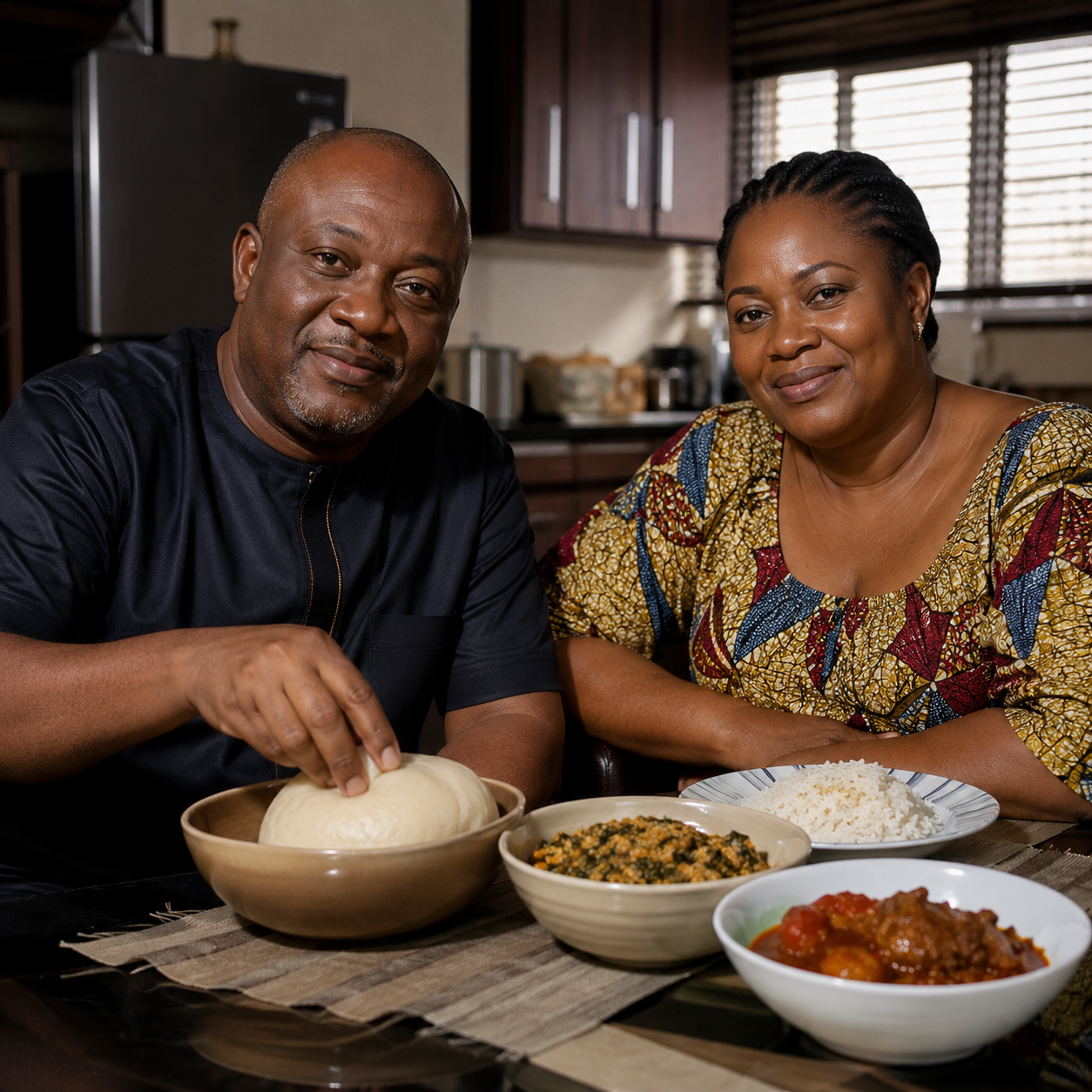
I am Emeka. My wife is Ngozi. We both live in Ibadan. We were both diagnosed with Type 2 diabetes within twelve months of each other. And for two years before we met Mama Okafor, we did everything wrong — spending money, suffering, and slowly watching the disease tighten its grip on our bodies and our home.
Every morning I woke up and the first thing I did — before I spoke to anyone, before I drank water, before I allowed the day to begin — was reach for my glucometer. And every morning I would look at the number on the screen and feel the same thing. Not fear exactly. Worse than fear. Resignation.
My doctor said the words I was most afraid of at my last appointment:
"Emeka, if we cannot get these numbers down, we are going to have a serious conversation about insulin. And after that — we monitor for complications. Kidney function. Eye pressure. And the feet. You must examine your feet every day."
The feet.
I knew exactly what that meant. I had a cousin. Strong man. Business owner. He had diabetes for six years without managing it properly. He lost two toes first. Then the foot. Then the leg below the knee. He was 54 years old, sitting in a wheelchair at a family gathering, watching his grandchildren run around him. A man who had built things, provided for people, carried a household on his shoulders — sitting in a wheelchair at 54.
I sat in that plastic chair in my doctor's office and smiled and nodded and said "yes sir, I will be careful." Nigerian man fashion. Inside, I was terrified.
◆
The Things Nobody Tells You Until It Is Too Late
They do not tell you that uncontrolled blood sugar slowly destroys your kidneys — year by year, silently — until one day the doctor shows you your kidney function test and the number has dropped so far that dialysis becomes the conversation. Three times a week. For the rest of your life.
They do not tell you about diabetic retinopathy — the way excess glucose attacks the tiny blood vessels behind your eyes. The way vision begins to blur at the edges. The way some Nigerian men and women discover they have been going blind, slowly, until the day they cannot read the number on their own glucometer anymore.
They do not tell you about diabetic neuropathy — the nerve damage that starts in the feet. The pins and needles. The numbness. And then the most dangerous part: when you cannot feel a wound on your foot. When a small cut becomes infected and you do not notice until the surgeon is explaining what has to come off.
They do not tell you what insulin injections actually mean as a daily life. Not as a threat from your doctor — as your actual morning, every morning, for the rest of your life. The needle. The timing. The way it announces itself to every person in your household. The way it removes every last pretence that this disease is manageable quietly.
These are not worst-case scenarios. These are what happen when a Nigerian man or woman manages diabetes with the wrong information for long enough.
I was managing with the wrong information. And I did not know what right looked like. Until Mama Okafor.
◆
Two Years of Trying Everything Wrong
When Ngozi was diagnosed twelve months after me, something shifted in our household. We were now two people managing the same disease in the same kitchen, sitting at the same table — and yet managing completely separately. Each carrying our own quiet fear. Neither willing to fully burden the other.
We tried everything they told us to try.
We tried the hospital diet sheet — brown rice, grilled fish, steamed vegetables, oat porridge. Ngozi looked at it, looked at her kitchen — the egusi on the shelf, the stockfish soaking in the bowl, the palm oil, the crayfish — and put the sheet in a drawer. It is still there.
We tried removing salt completely. Four months. Nobody told us that the Maggi cube we kept using had more sodium than the table salt we removed. Our numbers barely moved.
We tried bitter leaf juice every morning — both of us, standing in the kitchen at 6am, drinking something that smelled like the inside of a traditional medicine market. Six weeks. My reading moved by 0.4 points. Ngozi's by 0.6. We stopped talking about it.
Herbal capsules from Instagram — ₦35,000. Two months. The testimonials on their page were stock photos. Our readings at the end: identical to the beginning.
Private nutritionist — ₦28,000 — Gave us a meal plan with quinoa, avocado, and rocket salad. Ngozi followed it for eleven days. Then she sat down and said quietly: "Emeka, this is not our food."
Cutting all carbohydrates — Three weeks. I cooked eba for the family and ate boiled eggs alone. My energy collapsed. My doctor said this approach was dangerous for my specific diabetes type.
Hospital diet sheet — Five days. Brown rice imported from Lagos at four times the cost of ordinary rice. Grilled fish with no seasoning. I lasted five days before I accepted it would never be sustainable.
Magnesium supplements — ₦13,000. No framework. No timing. No visible result at six weeks.
Total spent on things that did not work: over ₦72,000. My doctor mentioned insulin again at my next visit. Ngozi's doctor mentioned kidney monitoring.
That evening I sat alone in our living room after the children had gone to bed and I thought — is this what we are? Two people who will spend the next thirty years slowly getting worse? Who will watch each other deteriorate across this same table?
That was my lowest point.
The Naming Ceremony That Changed Our Lives
Two weeks after that Wednesday evening, my business partner Chukwudi held a naming ceremony in Awka. Large family gathering. Every table loaded with jollof, pepper soup, pounded yam, egusi soup thick with stockfish and crayfish.
I sat in front of my carefully portioned plate, doing what I had been doing at every family gathering for two years. Calculating. Watching. Eating less than everyone else at a table I was sitting at in my best agbada, at a celebration I was supposed to be enjoying.
An elderly woman seated beside me watched this quietly for about ten minutes. Then she leaned over and said, in a voice warm as firewood:
"You have sugar, abi? I can tell by how you are looking at that egusi like it owes you an apology."
I laughed for the first time in months.
Her name was Mrs. Ngozi Okafor. Retired Senior Dietitian. University of Nigeria Teaching Hospital, Enugu. Thirty-two years in clinical nutrition — the last decade of which she spent specifically studying how Nigerian traditional foods, herbs, and preparation methods interact with blood sugar at a biochemical level.
Not Western food. Not pasta and brown bread research adapted for Nigeria. Egusi. Eba. Uziza. Bitter leaf. Ofada rice. The food we actually eat.
I called Ngozi over. We sat with Mama Okafor for two hours. I told her everything — the failed solutions, the money spent, the readings, the kidney monitoring conversation, the insulin warnings, the morning I checked my feet.
She listened without interrupting. When I finished she was quiet for a moment. Then she said something I have been repeating ever since:
"Emeka, every solution you tried was designed for a British body eating British food. The research behind that hospital diet sheet was conducted on people eating bread. Nobody in that research had a pot of egusi soup on the stove. When they told you to reduce salt — they were thinking of a salt shaker. They did not know about your Maggi cube, your crayfish, your stockfish. You have not been failing. You have been following advice that was never meant for you."
She then told us something that no doctor, nutritionist, or online resource had ever told us in two years of searching.
She told us about the four herbs.
Are You Tired of This?
Because if you are managing diabetes right now — you know exactly what this feels like.
And it needs to be said out loud before we continue.
Tired of waking up every morning and reaching for the glucometer before you speak to anyone. Before the day begins. And then carrying whatever number appears — good or bad — completely alone.
Tired of sitting at Christmas tables and naming ceremonies in front of a small careful plate while everyone around you eats freely from the food you used to eat without thinking.
Tired of your doctor's face at every appointment. The way he says "we need to monitor the kidneys" or "we should consider insulin" — sentences that follow you home and sit at your table with you.
Tired of the fear you do not say aloud. The cousin who lost his leg. The uncle on dialysis. The colleague whose vision began to fail. The stories you carry because saying them makes them feel closer to your own life.
Tired of looking at your feet every morning. Checking for wounds you might not feel. Living with that specific knowledge of what happens when this disease is managed with the wrong information for long enough.
Tired of spending money on things that do not work — herbal capsules, private nutritionists, supplements from Instagram — the shelf full of bottles that promised everything and changed nothing.
Tired of being the person in the household who eats separately from everyone else. The different plate. The quiet calculation before every mouthful. The specific sadness of cooking a meal for your family that you cannot eat the same way they eat it.
You are not broken. You are not being punished. You are a Nigerian man or woman who has been given advice that was designed for someone else's kitchen — and who has been failing faithfully, expensively, and exhaustingly trying to follow it. Until now.
What Your Grandmother's Kitchen Had That Yours Does Not
Mama Okafor asked us a question that evening that I have never stopped thinking about.
"Your grandfather — did he have diabetes?"
No. My grandfather ate eba every day of his life. He ate pounded yam at every gathering. He cooked with palm oil, crayfish, stockfish. He never counted a carbohydrate in his life. He died at 82 of old age.
"And what was always in his kitchen that is no longer in yours?"
Four things. She named them one by one. As she named them, I realised they had all been in Nigerian kitchens for generations — used daily, instinctively, without anyone knowing the science behind why they were protective. Until modern cooking habits, urbanisation, and the rush of daily life gradually pushed them out.
Contains vernonioside compounds that improve how your cells respond to insulin — reducing the glucose that remains in your bloodstream after a meal. Research from the University of Nigeria confirms its hypoglycaemic effect. The critical finding Mama Okafor emphasised: whole leaf cooked directly into ofe onugbu delivers these compounds far more effectively than extracted juice taken alone on an empty stomach. Most Nigerian diabetics using bitter leaf are using the weakest possible method.
Contains eugenol — a compound with documented blood sugar lowering properties. Research confirms it activates the same glucose metabolism pathways that diabetes medication targets, through a different mechanism and at a gentler scale. It has been in Nigerian pepper soup for generations. Most Nigerian diabetics adding scent leaf to their pepper soup are already receiving a blood sugar benefit — they just do not know it. The correct quantity changes everything.
🌿 Uziza Leaf (Piper guineense)
Contains alkaloids that slow the rate at which your gut absorbs carbohydrates from the meal. When uziza is present in a native stew eaten alongside eba or rice, the glucose from those starches enters your bloodstream significantly more slowly. The spike is smaller. The reading the following morning is lower. This is not folklore — this is physical biochemistry.
🌿 Unripe Plantain (Musa paradisiaca)
When cooked and eaten immediately while hot, unripe plantain behaves as a carbohydrate. When cooked, cooled for at least four hours, and then reheated — the starch converts to resistant starch. Your body processes it as dietary fibre. The blood sugar impact drops dramatically. Research from the University of Lagos documents this specifically. Your grandmother prepared her plantain this way. Not because she knew the science. Because that was simply how it was always done.
The herbs are still in your market. The knowledge was missing. Until now.
◆
The Three Preparation Switches That Change Everything
Alongside the four herbs, Mama Okafor documented three specific changes to how Nigerian staple foods are prepared that alter their blood sugar impact without changing what you eat or what your family eats.
Switch One applies to eba, rice, pounded yam, and fufu. A preparation change that happens between the moment of cooking and the moment of eating — converting digestible starch into resistant starch and reducing the glycaemic impact of the meal by up to 40%. Your family eats the same food. They notice nothing different.
Switch Two is about the order in which food arrives in your stomach. The sequence in which you eat the components of a Nigerian meal determines how quickly carbohydrates enter your bloodstream. Nigerian food already contains the solution: the soup. The switch specifies the exact sequence that maximises its protective effect.
Switch Three applies to the ratio of soup to swallow on the plate. The traditional Nigerian plate has shifted toward more swallow and less soup. Reversing that ratio changes the glycaemic outcome of every meal.
No new ingredients. No separate cooking. Your family eats exactly what they have always eaten. Only your glucometer reads the difference.
◆
What Happened When We Applied It
We started the method the very next morning after that naming ceremony. Not gradually. From the first meal.
Day one, two, three — nothing dramatic. My readings moved slightly. I kept going because I had nothing left to lose.
Day 8.
I checked my glucometer as I always do, before the day began. The number appeared on the screen. I stared at it. Checked it again. Shook the device — the way you shake something when you cannot trust what it is telling you.
I called Ngozi from the bedroom.
She came in, still in her headtie from the night before. I held the glucometer toward her without saying anything. She looked at the screen. She looked at me. Several seconds of silence.
Then: "Emeka. Is this real?"
It was the lowest reading I had recorded in two years of managing this disease.
By Week 4 my readings were consistently below 7.0. By Week 8 my doctor looked at my HbA1c and leaned back in his chair with an expression I had never seen from him.
"Whatever you are doing — keep doing it."
He reduced my medication at that visit. First time in two years. Ngozi's doctor made the same comment at her next appointment.
We were not on a different diet. We had not stopped eating Nigerian food. We were eating egusi soup. Eating eba. Eating jollof at the weekend. Just prepared differently. With the herbs that always belonged there, used correctly for the first time.
Over 300 Nigerian men and women from Lagos to Birmingham to Toronto have now reached us through this blog. We packaged everything into one complete guide so that no Nigerian diabetic has to spend two years and ₦72,000 the way we did before they find this.
Introducing
The Emeka Sugar Control System™
By Emeka & Ngozi Obi — NaijaHealthTalk Blog The complete Nigerian herb and food preparation protocol — for men AND women — based on everything Mrs. Ngozi Okafor documented in 32 years at UNTH Enugu.
Everything Inside The Emeka Sugar Control System™
✦The Four Nigerian Herb Protocol — Bitter leaf, scent leaf, uziza, and unripe plantain. Exact quantities, correct timing, how to incorporate each herb into Nigerian cooking, and a complete medication safety guide covering Metformin, glibenclamide, and insulin. — Pg. 4
✦The 3 Preparation Switches — Apply to your kitchen tonight. See a difference in your morning reading this week. Works for both men and women in the same household. — Pg. 9
✦The Nigerian Food Glycaemic Index — 40+ Nigerian foods rated. Eba, jollof, pounded yam, ofada rice, egusi, ofe onugbu, moi moi, pepper soup — each explained with its blood sugar impact and how to modify it. — Pg. 15
✦The 8-Week Nigerian Diabetic Meal Plan — Two months of daily meals using only foods from any Nigerian market. One meal for the whole household. Diaspora version included for African stores in London, Houston, Toronto, Birmingham. — Pg. 23
✦The Celebration Eating Protocol — How to eat freely at Christmas, owambe, naming ceremonies, and family gatherings. The specific eating sequence that neutralises the blood sugar impact of celebration food. — Pg. 38
✦What Your Numbers Mean — Plain Language — Fasting readings, post-meal readings, and HbA1c explained simply, with target ranges and exactly what to do when a number is higher than expected. — Pg. 44
✦The Medication Safety Guide — Which herbs are safe with which medications. Which combinations to avoid. How to have the conversation about medication reduction as your readings improve. — Pg. 51
✦The Doctor Visit Preparation Checklist — What to track, bring, and ask at your next clinic appointment. — Pg. 56
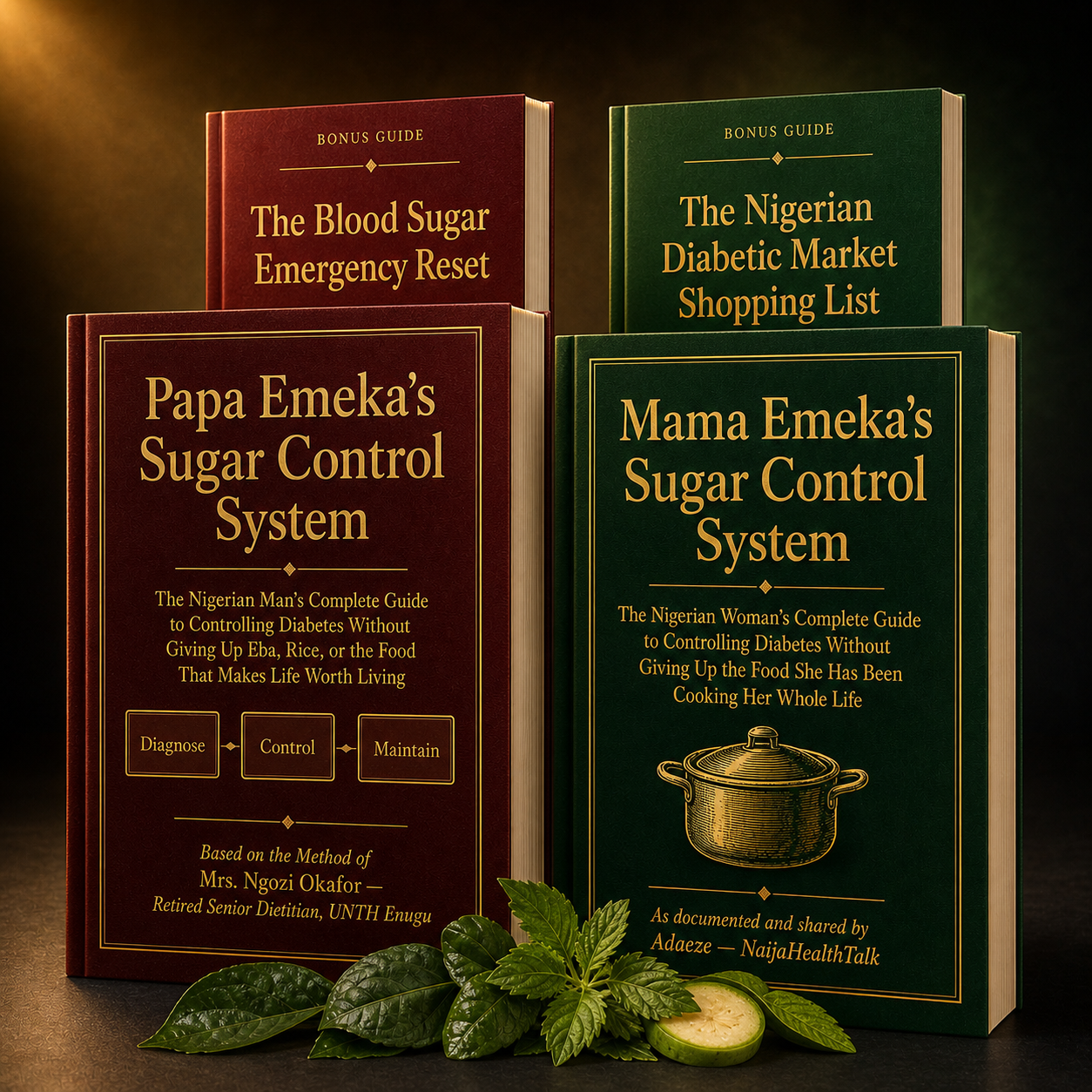
✦Covers Both Men and Women — Papa Emeka's System for the man. Mama Emeka's System for the woman. One purchase covers your whole household. — Both guides included
What This Costs vs. What Uncontrolled Diabetes Costs
One hospital specialist consultation₦30,000 – ₦80,000
🔒 Secure checkout via selar • Card / Bank Transfer / USSD • Instant download
8Spots Remaining at This Price
⚠️ Once these spots are gone, the price returns to ₦19,800
Every day you wait is another morning reaching for the glucometer with the same dread. Another number. Another silence. Another day closer to the conversation you are most afraid of.
WhatsApp messages from men and women who applied this method
← SWIPE TO SEE MORE
E
Emeka O. — Enugu
online
Yesterday
My doctor dey threaten me with insulin for months. I follow this method for 3 weeks.
8:42 AM
My fasting drop from 9.8 to 6.4. SIX POINT FOUR.
8:43 AM
Emeka! 😭 What specifically worked best for you?
8:45 AM✓✓
The bitter leaf in the soup — not the juice. That one alone changed my morning number. And the preparation switch for eba. I never stop eating my food once.
8:47 AM
My doctor asked what I changed. I just smiled 😂 God bless whoever made this guide.
8:48 AM
N
Ngozi A. — Ibadan
last seen today
3 days ago
I and my husband we both have sugar. Been managing separately for 2 years.
11:14 AM
This guide is the first thing that covers both of us. One kitchen. One meal. Both readings improving.
11:15 AM
This is exactly why we built it that way! What are your current readings?
11:17 AM✓✓
His was 10.3 when we started. Now 6.8. Mine was 9.7. Now 6.4. Week 6.
11:18 AM
We ate at my mother's birthday. Full plate. No restricted food. Readings still good next morning. This thing is not a joke. 🙏🏾
11:19 AM
B
Biodun O. — Birmingham UK
online
Last week
Nigerian in Birmingham. NHS GP gives me advice for someone who eats toast and cucumber. She has never heard of egusi soup.
7:31 PM
Applied the herb protocol with ingredients from my African shop in Handsworth.
7:32 PM
How have the readings been? 🙏
7:34 PM✓✓
5 weeks in. Consistently below 7.5 for the first time since diagnosis. My GP printed out the herb section and said the science is sound. She said the science is SOUND. 😭🇳🇬
7:36 PM
What You Receive Today
Plus These Powerful FREE Bonuses
Bonus 1
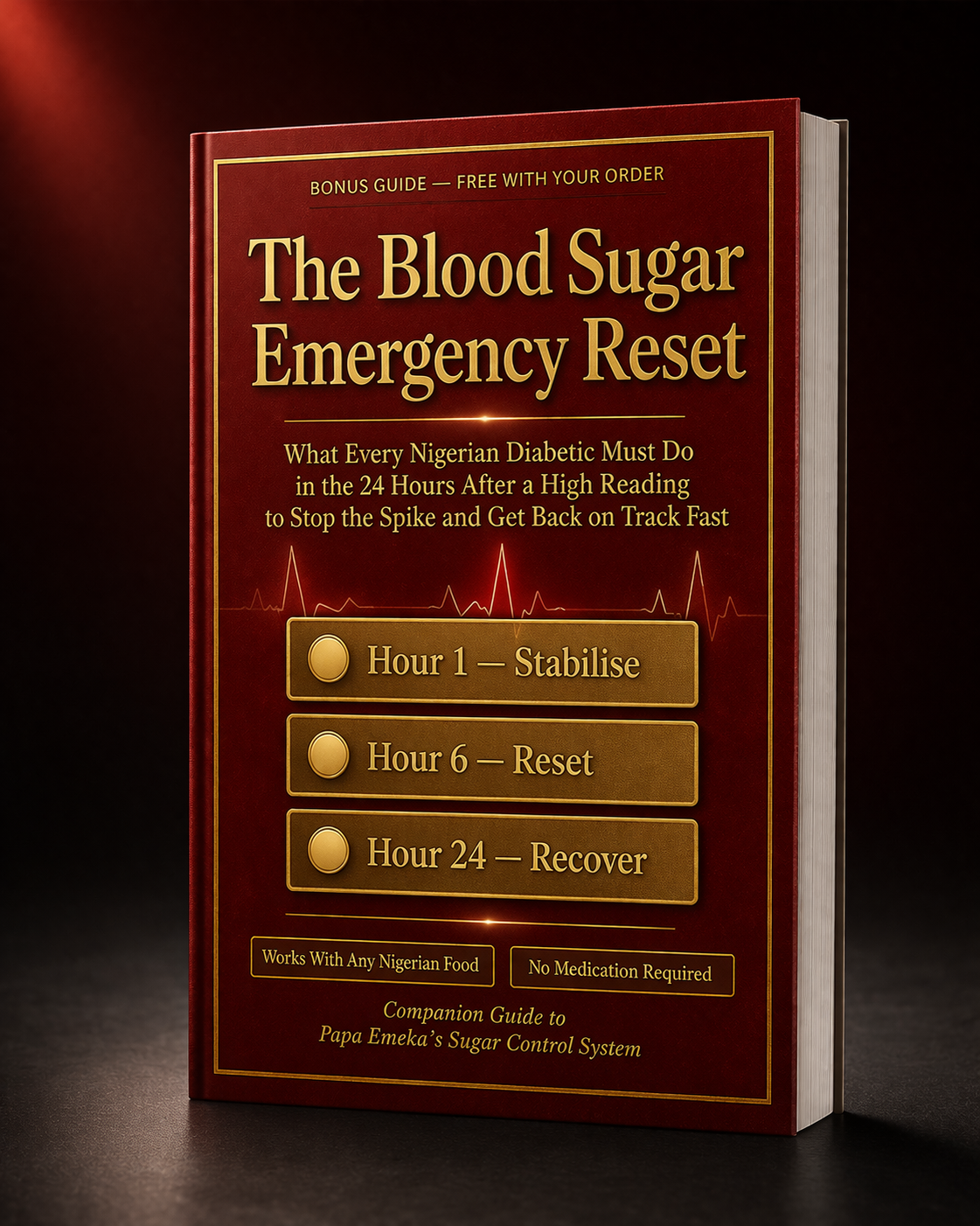
The Blood Sugar Emergency Reset
Value: ₦5,000 — Yours FREE
What to do in the 24 hours after a high reading. A step-by-step action protocol when your numbers spike after a celebration, a stressful week, or a dietary slip. Stops the panic and gets you back in range fast using Nigerian food and the herbs inside this system.
Bonus 2
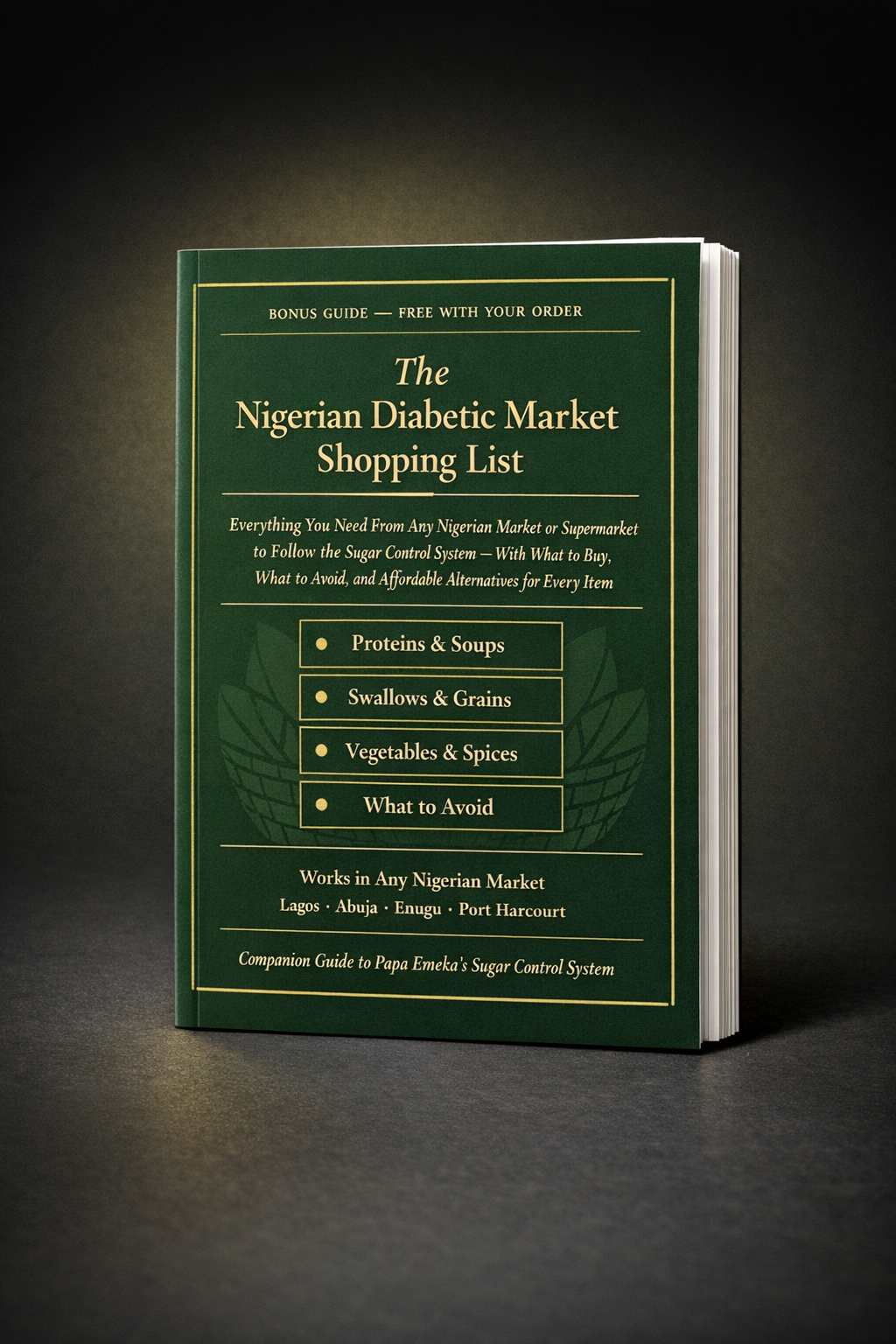
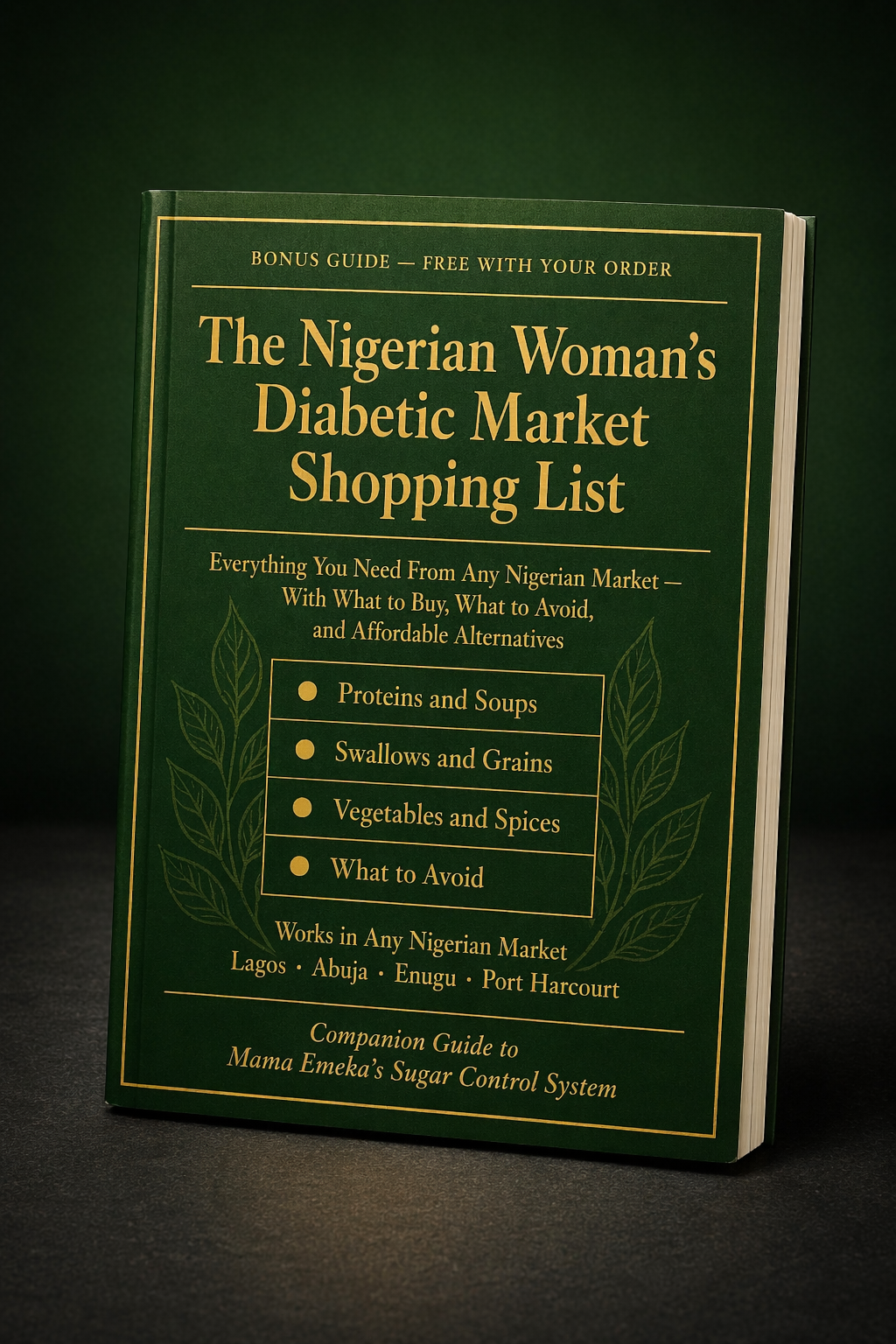
The Nigerian Diabetic Market Shopping List
Value: ₦4,000 — Yours FREE
Every ingredient needed for the herb protocol and preparation switches — with local names in Yoruba, Igbo, and Hausa. What to buy, what to avoid, affordable alternatives. Diaspora version included for African stores in London, Houston, Toronto, and Birmingham.
Bonus 3
The Mama Emeka Women's Companion Guide
Value: ₦5,000 — Yours FREE
The female-specific version of the full protocol — written for the Nigerian woman who manages her own diabetes while cooking for her household and attending celebrations. Same herbs. Same switches. Written in the specific language of a woman who cooks, manages, and refuses to eat separately from her table forever.
★ ★ ★ ★ ★
✨ SPECIAL BONUS: 30-Day Private WhatsApp Support Access
For the next few days only — every person who orders gets 30 days of access to our private support group where Ngozi and I answer questions directly. Your specific herb combinations. Your meal plan. Your readings. Your doctor conversations. You will not be figuring this out alone. We went through two years alone. You do not have to.
✦The Emeka Sugar Control System™ — Papa Emeka's Complete Guide (for men)
✦The Emeka Sugar Control System™ — Mama Emeka's Complete Guide (for women)
✦The Four Nigerian Herb Protocol with complete Medication Safety Guide
✦The 3 Preparation Switches — Apply Tonight
✦The 8-Week Nigerian Diabetic Meal Plan (Nigeria + Diaspora versions)
✦BONUS 1: The Blood Sugar Emergency Reset (Value: ₦5,000)
✦BONUS 2: The Nigerian Diabetic Market Shopping List (Value: ₦4,000)
✦BONUS 3: The Mama Emeka Women's Companion Guide (Value: ₦5,000)
✦SPECIAL BONUS: 30-Day Private WhatsApp Support Access
◆Total Value: Over ₦70,000 — You Pay Just ₦9,800 Today
What Nigerian Diabetics Are Saying
Verified buyer testimonials — updated weekly
KA
Kayode Adebisi
🇳🇬 Ibadan, Oyo State
★★★★★
My HbA1c went from 9.1 to 6.8 in eight weeks. I used the bitter leaf correctly in the ofe onugbu for the first time in my life — not as juice, in the soup. That one change alone shifted my reading by almost a full point in week one. This guide understands our food in a way nothing else I have tried ever has. My doctor is quietly shocked.
FA
Fatima and Sule Abdullahi
🇳🇬 Abuja, Nigeria
★★★★★
We are a couple. Both diabetic. Managing separately for two years. This guide gave us a shared system for the first time. Week 6 — his reading 6.4, mine 6.9. We attended my sister's naming ceremony and ate properly at the table. No restricted plate. No calculation. Our morning readings cooperated. We cried together that morning. Genuinely.
GE
Godwin Ezeama
🇳🇬 Owerri, Imo State
★★★★★
I bought this for my father after his doctor mentioned kidney monitoring at his last visit. He is 67. He read this guide himself — said it was the first diabetes resource that spoke to him like a Nigerian man. Six weeks later his kidney function test had improved. His fasting glucose dropped from 12.1 to 7.3. I am still finding words for this.
PO
Prince Obi
🇺🇸 Maryland, USA
★★★★★
My doctor in Maryland told me I was borderline for insulin. I found this guide the week after that appointment. Six weeks of the herb protocol and preparation switches. At my next appointment my doctor said we would not be discussing insulin at this visit. She looked up the herb section herself and said — "the science is there. Keep doing this." ₦9,800 may have saved me from insulin. I cannot overstate that.
TO
Tunde Okonkwo
🇨🇦 Toronto, Canada
★★★★★
I sent this guide to my mother in Abuja after her doctor mentioned her eyes at the last visit. Diabetic eye changes. Early stages. She was terrified. Eight weeks of the herb protocol. At her next eye examination the ophthalmologist said progression had slowed significantly. She called me crying. I cried too. I am not ashamed. ₦9,800 and eight weeks. That is what this cost.
🛡️
30-Day Money-Back Guarantee
Try The Emeka Sugar Control System™ for a full 30 days. Apply the herb protocol. Apply the preparation switches. Follow the meal plan. If you do not see measurable improvement in your blood sugar readings — contact us directly and we will refund every naira. No questions. No forms. No delay. You have spent enough money on things that did not work. You will not lose another naira on this one if it does not deliver.
I bought this for my husband who would not buy it for himself. Nigerian men — they manage quietly and they suffer quietly. He read the whole guide in one sitting. He started the scent leaf in his pepper soup and the preparation switch for his eba immediately. Week 5 reading: 6.6. Down from 10.4. His doctor reduced his medication at the last visit. He has not said much to me about it. But he made me egusi soup and brought it to me in the living room last Sunday. That said everything.
MI
Musa Ibrahim
🇳🇬 Kano, Kano State
★★★★★
As a Northern Nigerian I was worried this guide would be only for Yoruba or Igbo food. They included tuwo shinkafa, miyan kuka, masa — my actual food. And the uziza equivalent herb guidance works for the northern kitchen too. The preparation switch for rice works for our tuwo. Wallahi this guide is something different. My wife is happy. My doctor is happy. I am happy. That combination has not happened in two years.
IO
Ifeoma Okeke
🇳🇬 Enugu, Nigeria
★★★★★
I was managing diabetes for four years by eating separately from my family at every single meal. Four years of a different plate. Four years of watching my children eat what I cooked while I sat in front of something smaller and sadder. My daughter asked me once why my food always looks different. I could not answer her. This guide ended that. Week 6 — my plate looks like everyone else's. My daughter has not asked that question again.
Before You Decide — Three Questions You Are Probably Asking
❓ "Is this real? How is it different from every other Nigerian diabetes product?"
The difference is in what it is built on. This is not assembled from general diabetes research adapted for Nigeria. It is built on 32 years of clinical observation from a UNTH Senior Dietitian who spent her career specifically studying Nigerian food and blood sugar — not Western food. Not research done on people eating bread. Research done on people eating eba and egusi and uziza. My name is Boluwarin. WhatsApp: +234 915 642 2131. Email: coachboluwarin@gmail.com. A real person who answers real messages. If it does not work, you get your money back.
❓ "I have tried bitter leaf, herbal capsules, everything. Why will this be different?"
The difference is not the herb — it is the protocol. Bitter leaf juice taken alone on an empty stomach is the weakest possible method. Whole leaf cooked directly into ofe onugbu delivers the active compounds differently, more effectively, with the palm oil and protein of the soup creating a synergistic effect the juice cannot replicate. The same is true for every herb in this guide. The herbs were never the problem. The method was missing. This guide provides the method.
❓ "What if it doesn't work for my specific body?"
Then you contact us and we refund every naira. 30 days. No questions. No forms. No argument. You have already spent money on things that did not work. You will not lose another naira on this one if it does not deliver.
Frequently Asked Questions
Yes — and this is why we included a full Medication Safety Guide. We specifically cover Metformin, glibenclamide, and insulin — which herb combinations are safe alongside each, and which to avoid. The protocol is designed to work alongside your existing treatment, not to replace it. Always inform your doctor of any dietary or herbal changes you make.
Most people notice a change in their morning fasting readings between Day 5 and Day 10. By Week 4, the majority of people following the complete protocol are seeing consistent improvement. By Week 8, the change is documented enough to show your doctor. Individual results depend on how consistently the method is applied — but the 30-day guarantee exists because I am confident in what it produces.
Yes — we built the guide specifically with diaspora Nigerians in mind. Every herb in the protocol is available at African food stores in London, Birmingham, Houston, Atlanta, Toronto, and Brampton. The market shopping list inside includes diaspora equivalents for every item. You do not need to be in Nigeria to follow this protocol completely.
No. The preparation switches are applied to the same pot your family already eats from. Nobody cooks separately. Nobody eats a different meal. Nobody knows anything changed. Only the glucometer reads the difference.
Yes. One purchase gives you access to both guides — Papa Emeka's Sugar Control System for the man and Mama Emeka's Sugar Control System for the woman. One kitchen. One method. Both readings improving.
Immediately after payment is confirmed through selar, you receive a download link by email. The guides are PDFs — open them on your phone, tablet, or computer. Many people save them to WhatsApp Saved Messages so the herb quantities and preparation switches are always in the kitchen. Any issue after payment: WhatsApp +234 915 642 2131 and we resolve it within the hour.
You Now Have Two Choices.
✗ Do Nothing. Keep Going As Before.
Another morning with the same glucometer dread.
Another number that refuses to cooperate.
Another appointment where the doctor's face tells you something before his words do.
Another conversation about insulin. Kidneys. Eyes. Feet.
Another year of advice that was never designed for your kitchen.
✅ Take This Step.
A protocol built for Nigerian food. By Nigerians.
Four herbs already in your market. Used correctly.
Three preparation switches applied tonight.
Your family eating the same meal. Nobody separate.
Thirty days completely risk-free. Every naira back if it fails.
Perhaps God put this page in front of you today for a reason. You do not have to keep carrying this with the wrong information.
Your Investment Today — Both Guides + All Bonuses₦9,8003 FREE Bonuses • 30-Day WhatsApp Support • 30-Day Guarantee
P.S. — You have already tried things that did not work. You have already spent money that did not produce results. You have already managed this quietly and alone for longer than you should have. The Emeka Sugar Control System™ is built on 32 years of a UNTH dietitian's clinical observation of Nigerian bodies eating Nigerian food. It is the answer the hospital diet sheet could never be. At ₦9,800.
P.P.S. — You are protected by a full 30-day money-back guarantee. Follow the protocol. Apply the herb method. If your readings do not move — every naira returns to you. Zero financial risk. You take the risk of not knowing what this could have done for you. I take the financial risk.
P.P.P.S. — Only a few spots remain at ₦9,800. When they are gone, the price returns to ₦19,800. The time to act is right now.
You came to this page for a reason. The glucometer reading that keeps not cooperating. The doctor's face at the last appointment. The fear you carry but do not say out loud. You are still searching for something that works.
30 days. Full money-back guarantee. Zero financial risk.