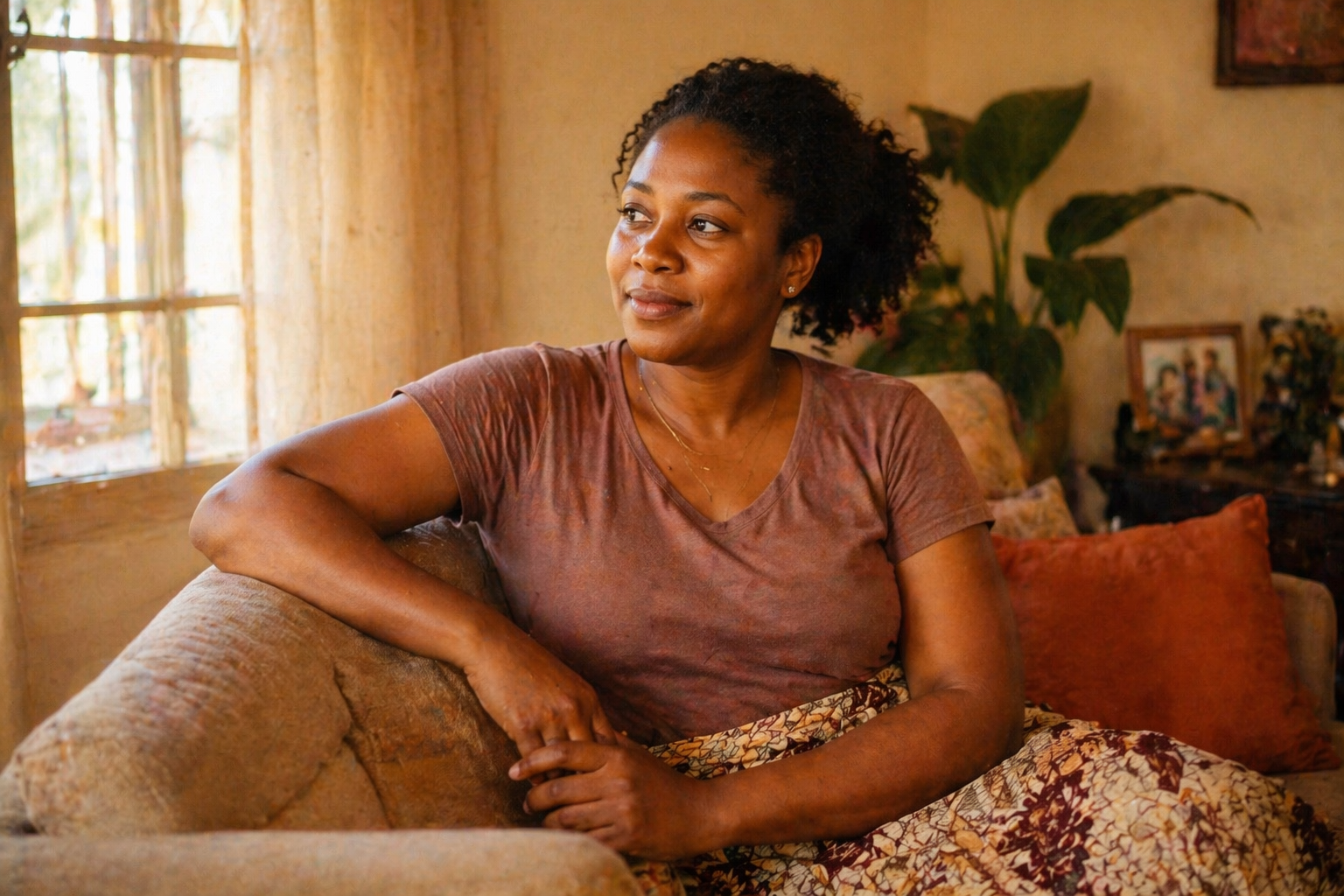
You love your husband.
You know you do.
He is a good man. He provides. He tries. He reaches for you at night and you do not pull away — but something inside you goes completely still when he does.
Nothing. Just… nothing.
And then comes the guilt. The quiet, heavy, suffocating guilt that follows you into the bathroom, into the kitchen, into the school run, into every ordinary moment of your day.
You lie there afterwards and you stare at the ceiling and you think:
"What is wrong with me?"
You used to want him so badly. You remember that version of yourself — the one who looked forward to nights, who reached for him first sometimes, who felt like a woman and not just a mother and a manager and a housekeeper wrapped in the skin of someone's wife.
Where did she go?
You have tried to snap yourself out of it. You have told yourself to "just be in the mood." You have prayed about it. You have lit a candle and put on something nice that now lives at the back of the drawer because you wore it once and felt ridiculous.
You have Googled it. At 1am, in the dark, hoping nobody would ever see your search history. And the results you found were either too clinical, too Western, or too generic to apply to your actual life — your actual exhaustion, your actual marriage, your actual Nigerian household where the concept of a woman's pleasure has never once been discussed openly.
You have started to wonder if this is just what marriage becomes. If this is the price of having children and building a life and growing up. If your mother felt this way. If every woman around you is quietly faking it and just not saying so.
Maybe you have even started to wonder about him. Is he patient? Is he noticing? Is he going to stop trying altogether one day — or worse, stop trying here?
That thought alone is enough to make you feel sick.
You are not a bad wife. You are not broken. You are not cold. You are not unfixable.
But you need help — private, real, no-judgment help — that nobody has been honest enough to offer you until now.
Drop everything you are doing right now and read every single word I am about to say.
Because I am about to share with you a simple 21-day ritual that changed everything for me — and has quietly changed everything for hundreds of women just like you.
Our grandmothers did not have this problem.
They raised ten children. They worked hard. They carried heavy loads — literally and figuratively. And they still maintained the kind of intimate marriage that held families together for decades. There was something they knew. Something passed down quietly, woman to woman, in kitchens and back rooms and the kind of frank conversation that modern women are too polished, too embarrassed, or too busy to have.
That knowledge did not disappear. It was simply buried under the rush of modern life, the silence of respectability culture, and the assumption that a woman's desire was not important enough to tend to.
It is important. It always was. And there is a way back to it.
Hi. My name is Adaeze.
The first thing you should know about me is that I am NOT a doctor, a therapist, or a relationship coach. I am just a 34-year-old married woman from Lagos — mother of two under five, wife for six years — who went through exactly what you are going through right now. And found a way through it that no doctor, pastor, or well-meaning friend ever gave me.

How It Started
It happened gradually. That is the thing nobody tells you about — it does not switch off all at once. It creeps. One night you are tired, so you let it go. The next night the baby woke up twice and you genuinely cannot. The next week your mind is full of school fees and your mother-in-law's visit and the chest freezer that needs repairing.
And one day you realise it has been six weeks. Then eight. And the guilt sets in. And the pretending starts.
My husband Emeka is a good man. Patient. Hardworking. He never pressured me, never made me feel bad. But I could see it. The small ways he stopped trying. The way he started going to sleep earlier. The way he stopped reaching for my hand in the car.
He was still there. But something between us was going quiet.
The Emotional Cost
I started wearing it like a private shame. On the outside — fine. We looked like every other Lagos couple. Church on Sunday. Family WhatsApp group. School photos. A good life.
On the inside? I felt like a fraud. Like I was holding a marriage together with the appearance of a marriage while something essential had gone missing and I could not find it.
I gained a little weight after the second baby and stopped feeling comfortable in my own body. I was touched-out from nursing and carrying and being climbed on all day — and by the time the children slept, the last thing my body wanted was more contact. I did not even know how to explain this to myself, let alone to Emeka.
So I said nothing. And the silence grew.
The Breaking Point
One Saturday morning, I found a Google search on Emeka's laptop. He had not deleted it. I do not think he even knew I had seen it. It was innocent — but it was enough.
"How to get closer to wife who is not interested."
I sat with that for a long time. He was searching too. He was as lost as I was. My good, patient husband was quietly trying to figure out how to reach a wife who had gone somewhere he could not follow.
That was the day I decided I had to do something real.
The Advice That Changed Nothing
I did what most Nigerian women do. I started quietly asking for help in the only ways available to us.
My pastor's wife told me: "Just submit, my sister. Your body belongs to your husband. Start there and your feelings will follow." I tried. They did not follow. They retreated further.
My older sister, laughing, told me I needed a holiday. "You're just tired, Ada. Take a break." A break from what, exactly? My children would still be there. My life would still be there. Tiredness was a symptom. It was not the root.
And then I did what no self-respecting Nigerian woman admits to doing — I tried everything I could find:
- Kayanmata: Bought from an Instagram vendor. Spent ₦18,000. It made me feel temporarily flushed but nothing deeper changed. The next week I was exactly where I started.
- A romantic weekend away: Emeka planned it beautifully. I felt so guilty about feeling nothing that the pressure made it worse. I cried in the hotel bathroom at 2am.
- Lingerie: Bought it. Wore it once. Felt like I was performing in a play about my own marriage. Put it in the back drawer and never touched it again.
- Herbal supplements from the pharmacy: Three different kinds. Two of them gave me headaches. None of them gave me desire.
- Just forcing myself: I did this for months. The performance of it made the distance worse, not better. Emeka could feel the difference even when I tried to hide it.
- Fasting and prayer: Genuinely. I believed this was a spiritual problem. I fasted for three days. I prayed. Nothing changed in my body. God heard me, I believe — but this was not a spiritual problem. It was a physical, emotional, and relational one. And it needed a different kind of answer.
The Chance Encounter
Three months after the Google search incident, my husband's family had a reunion in Ibadan. His grandmother's 80th birthday. About sixty people, three generations, a compound full of noise and food and the kind of warmth that only big Nigerian families produce.
I ended up in the kitchen with Mama Chidinma.
She is 71. Retired midwife. Married for 47 years before her husband passed. She has this way of looking at you — still and direct — like she has already seen everything and is simply waiting for you to catch up.
I do not know how it started. One moment we were pounding egrisi together and the next she was looking at me and saying, quietly:
"You are here but you are not here, Ada. What is happening with you and that husband of yours?"
I laughed it off. She did not move. She just waited. And something about being in that warm kitchen, surrounded by the smell of food and the sound of children outside, with this woman who had lived everything I was trying to navigate — something broke open in me.
I told her. Not everything. But enough.
What Mama Chidinma Told Me
She listened without interrupting. When I finished, she was quiet for a moment. Then she said:
"Those things you tried — the herbs from Instagram, the weekends away, the prayers — you were treating the smoke. Not the fire. The fire went out somewhere. You have to find where it went out and relight it from there. Not from the outside. From inside."
She told me that in her years as a midwife, she had watched what happened to women after childbirth that nobody talked about. The hormonal depletion. The way the body redirects everything toward the baby and leaves nothing for the wife. The emotional resentments that build silently because a woman in a Nigerian home is not permitted to say: "I am angry. I need something. I am not okay."
She told me there were five things that switched a woman's desire off. And until you found which one was yours — or which combination — no herbal mixture, no romantic weekend, no amount of willpower would bring it back.
She told me there were foods, rituals, practices — things her own mother had taught her, things she had learned in decades of midwifery — that worked with a woman's body rather than against it. Simple things. Patient things. Things that required twenty-one days of quiet, consistent effort rather than one dramatic intervention.
She looked at me very directly and said:
"Go home, Ada. And start at the beginning. Not his beginning. Your beginning. A woman who has lost herself cannot give what she does not have."
I Did Not Believe It At First
I want to be honest with you. I was skeptical.
It seemed too simple. Too quiet. After everything I had tried — the products, the prayers, the performance — the idea that twenty-one days of specific, grounded daily actions could restore something I had been mourning for almost two years felt almost insulting.
I took the notes she gave me and I put them in my bag and I thought: I'll try it. But it probably won't work.
The first five days — nothing dramatic. But something subtle. A kind of settling. Like a noise I had not noticed was slowly getting quieter. I started sleeping slightly better. I felt less resentful of being touched during the day — the children's hands, my husband's arm around my shoulder in the morning. Small things.
Day eight: I woke up and for the first time in I could not remember how long, I felt like myself. Not a mother first. Not a wife by obligation. Just a woman in her own body, with her own aliveness.
The Breakthrough
Day eleven.
Emeka came home late from work. I had already put the children to bed. We sat in the living room — something we had not done without phones in months — and we just talked. And somewhere in the middle of that conversation I felt something I had forgotten was possible.
I wanted him.
Not out of obligation. Not to stop the guilt. Not as a performance.
Just — I wanted him. The way I used to.
I will not tell you all the details of that night. But I will tell you that it was the first time in almost two years that I was completely present. And I cried afterwards. Not from sadness — from the pure relief of finding something I thought was gone forever.
When Emeka Noticed
He did not know about the ritual. He did not know about Mama Chidinma. He did not know about the twenty-one days.
About two weeks in, he looked at me one morning across the breakfast table and said:
"Ada. You look different. You look like yourself again."
I just smiled. He reached across the table and held my hand and said, quietly: "I missed you."
That was the real test. Not my own feelings — but the fact that someone who knew me, who lived with me, who loved me — could see the change from across a breakfast table without knowing what had caused it.
I Was Not the Only One
After the reunion, I learned that Mama Chidinma had quietly shared versions of this knowledge with other women at the gathering.
Ngozi, 38, from Enugu — who had been married for nine years and described her desire as having "died completely" after her third child — sent me a voice note four weeks after the reunion. She was crying and laughing at the same time. "Ada, it's back. I don't know how to explain it, but it's back."
Temi, a Lagos woman in her early forties who had been quietly considering whether her marriage was salvageable, messaged me on WhatsApp six weeks later: "I feel like I got married again. That's the only way I can describe it."
Blessing, a Nigerian woman living in South London who heard about it through Temi, called me from the UK at midnight her time, laughing: "My husband thinks I've found a new husband. I told him I found my old self."
That was when I knew I had to stop sharing this one woman at a time and put it somewhere that any woman who needed it could find it privately, at any hour, without embarrassment, and without having to tell a single soul.
After over a year of WhatsApp messages, voice notes, and late-night calls from women asking me to share exactly what I did — I sat down and wrote everything out.
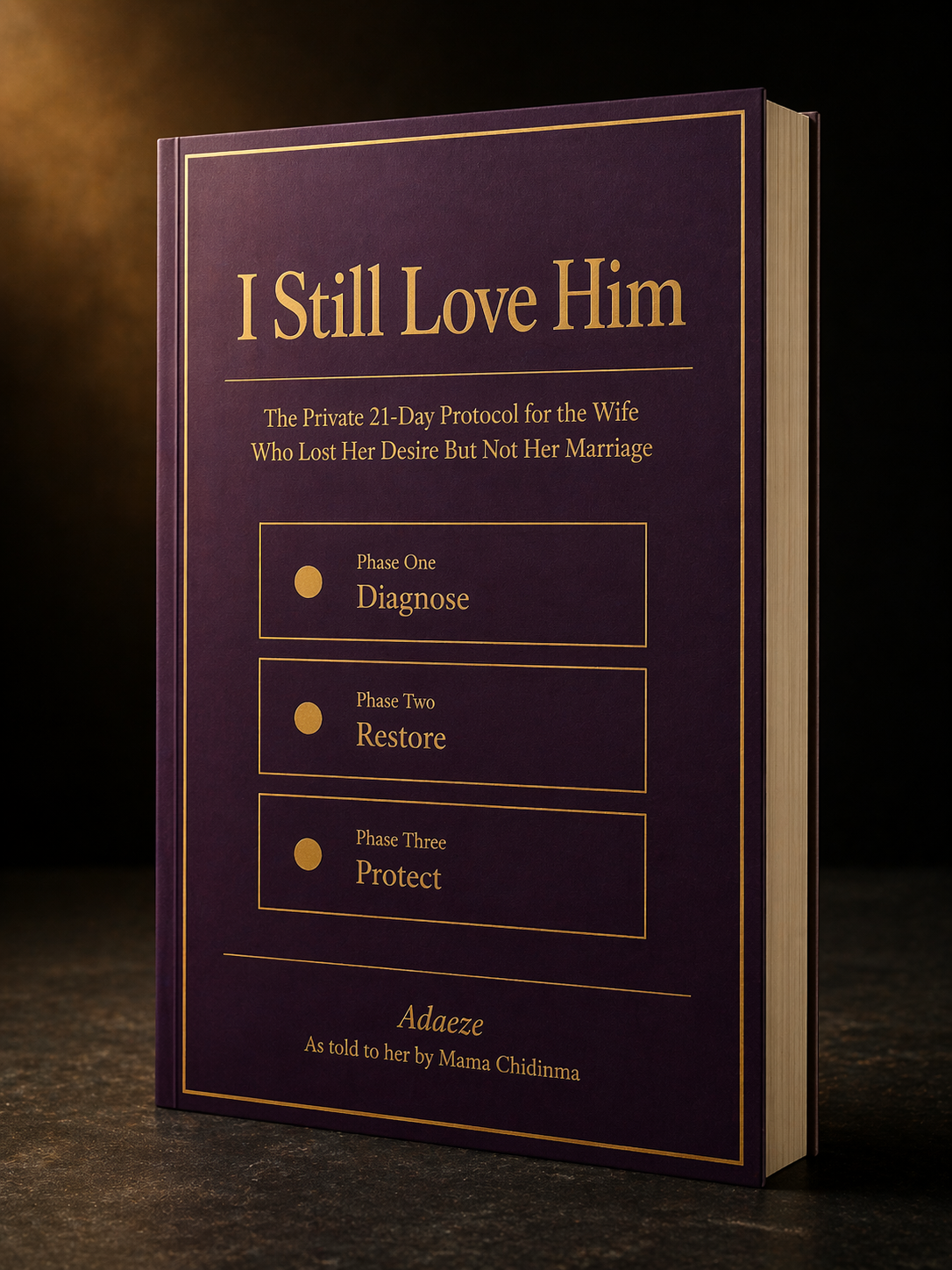
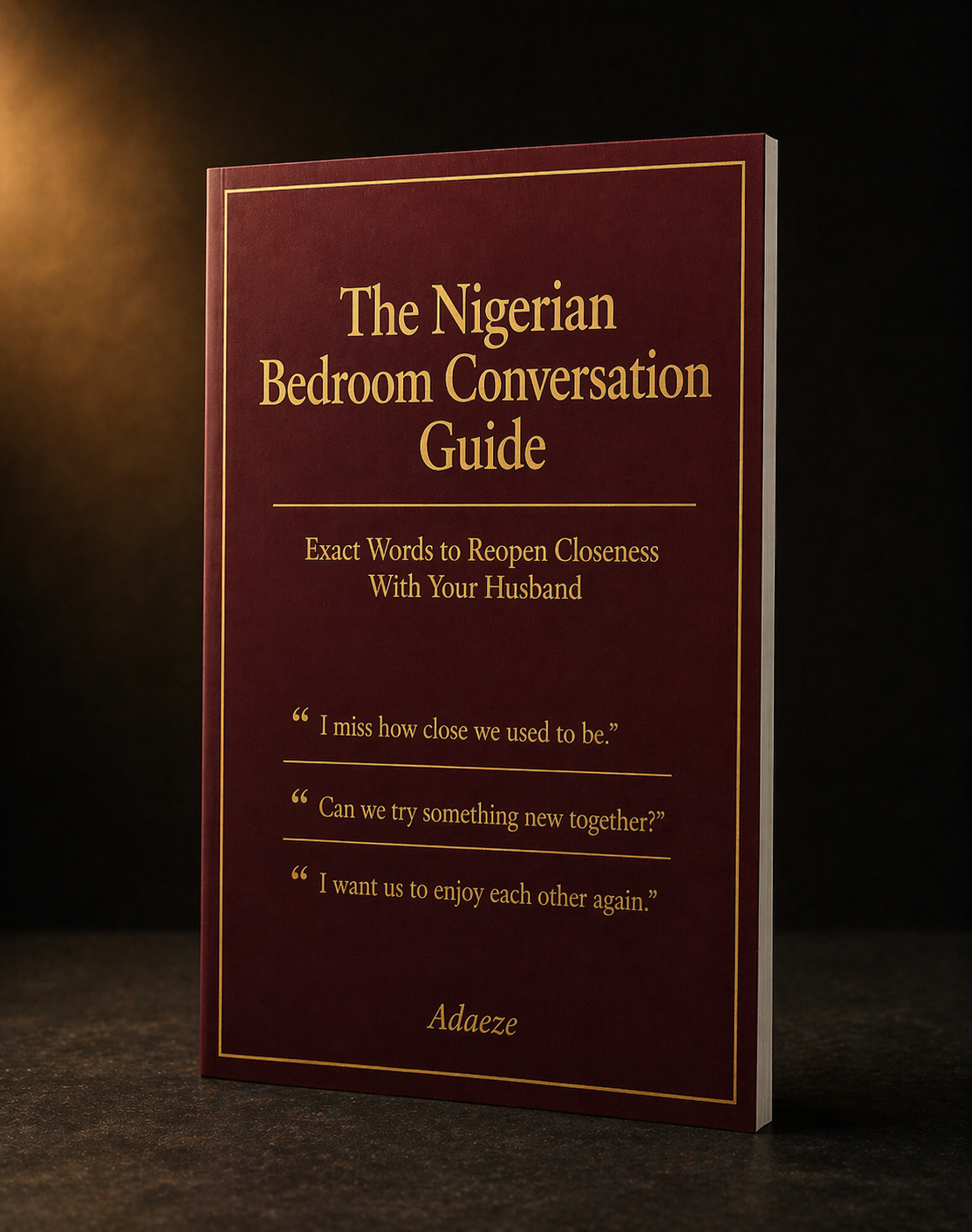
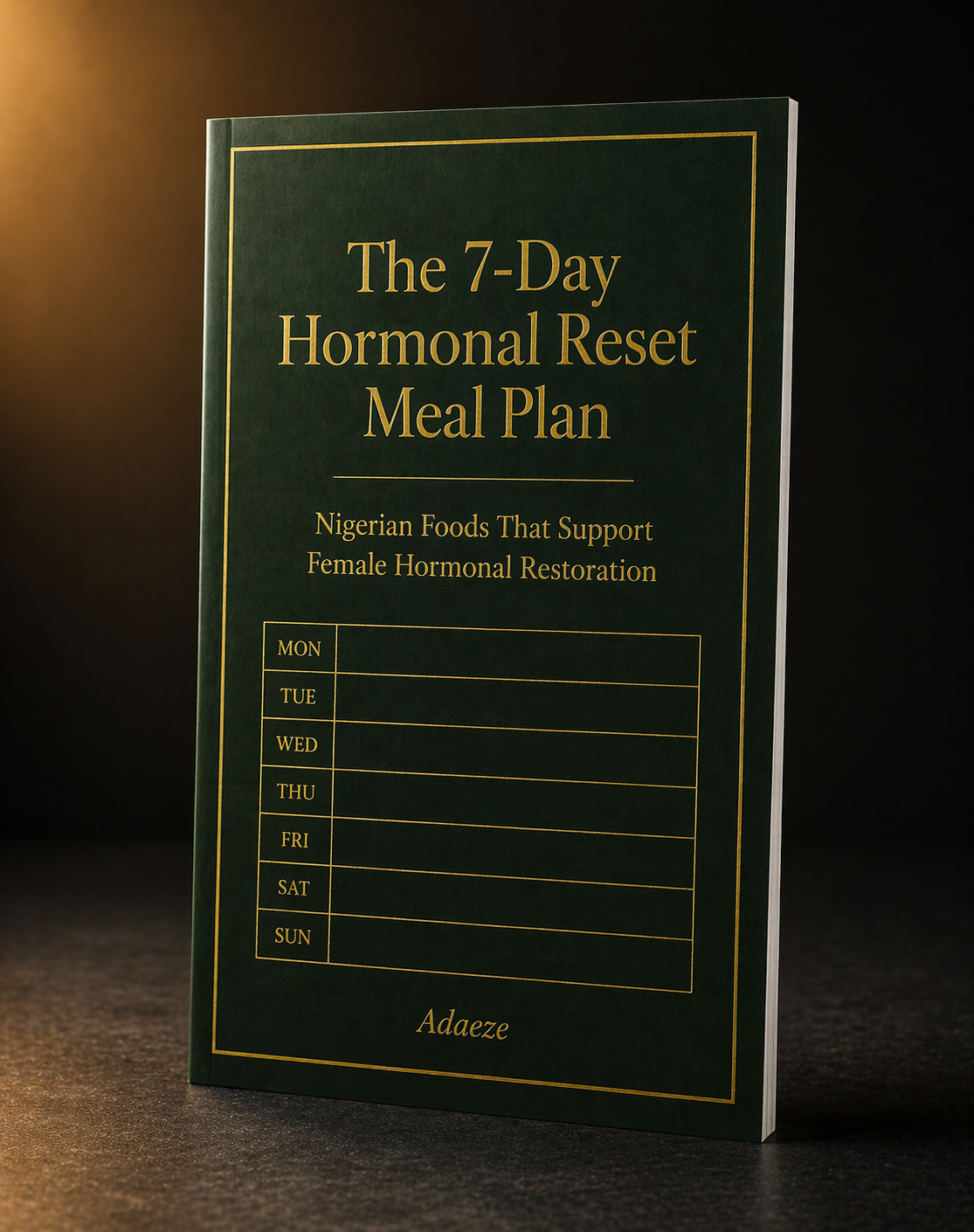
Everything Mama Chidinma taught me. Every step, in the exact order. The five root causes — and how to identify which one is yours. The foods and traditional ingredients available in any Nigerian market or African shop abroad. The daily practices. The conversation tools. The twenty-one day structure. Everything.
I put it all inside one simple private guide that you can read tonight, start tomorrow, and begin to feel results from within the first week.

Adaeze I don't even know how to start this message. I've been married 8 years and I thought something was genuinely wrong with me medically. The Desire Blocker Assessment on page 4 — I identified my problem in 15 minutes after 8 years of confusion. It was the emotional resentment one. I had things I never said that were blocking everything. The journal prompts on page 21 made me cry for two days — and then something lifted. My husband asked me last week what I changed. I told him I found myself again. He doesn't need to know the rest. THANK YOU.